- Summits
- Sponsorship
- Retreats
- Media Opportunities
- News
- About
Founded by a team of MedTech innovators with a proven track record, Auctus Surgical is on a mission to transform the treatment of adolescent idiopathic scoliosis (AIS). MedTech World recently interacted with the company’s leadership—John Ashley (Co-Founder and CEO), Murali Kadaba (Co-Founder and Chief Science Officer), and Damien Shulock (VP of Research & Development)—to learn more about their journey and vision. The trio previously collaborated at CoAlign Innovations, where they developed the first FDA-approved vertically expanding interbody fusion cage for adult low back surgeries.
The spark for Auctus Surgical came when UCSF approached the team about licensing a scoliosis prototype. While exploring the idea, they sought feedback from pediatric spine surgeons.
“As we spoke with key opinion leaders, it became clear that what they wanted was not the prototype we had demonstrated, but rather an improved tether,” recalled Damien Shulock. “That feedback guided us to design our Dynamic Tethering System, file the patent, and start the company.”
For John Ashley, the mission is also personal.
“I had previously witnessed the medical journey of the daughter of a colleague of mine after she received a diagnosis of AIS,” he shared. “At the age of 11, she had to wear a torso brace for more than 23 hours a day, and in her case—as with about 30% of children—it did not prevent further degeneration. After her 12th birthday, she underwent fusion surgery. Her spine was straightened, but it could no longer move or continue to grow. She lost the ability to participate in activities she loved. I thought there had to be a better solution for her and children like her.”

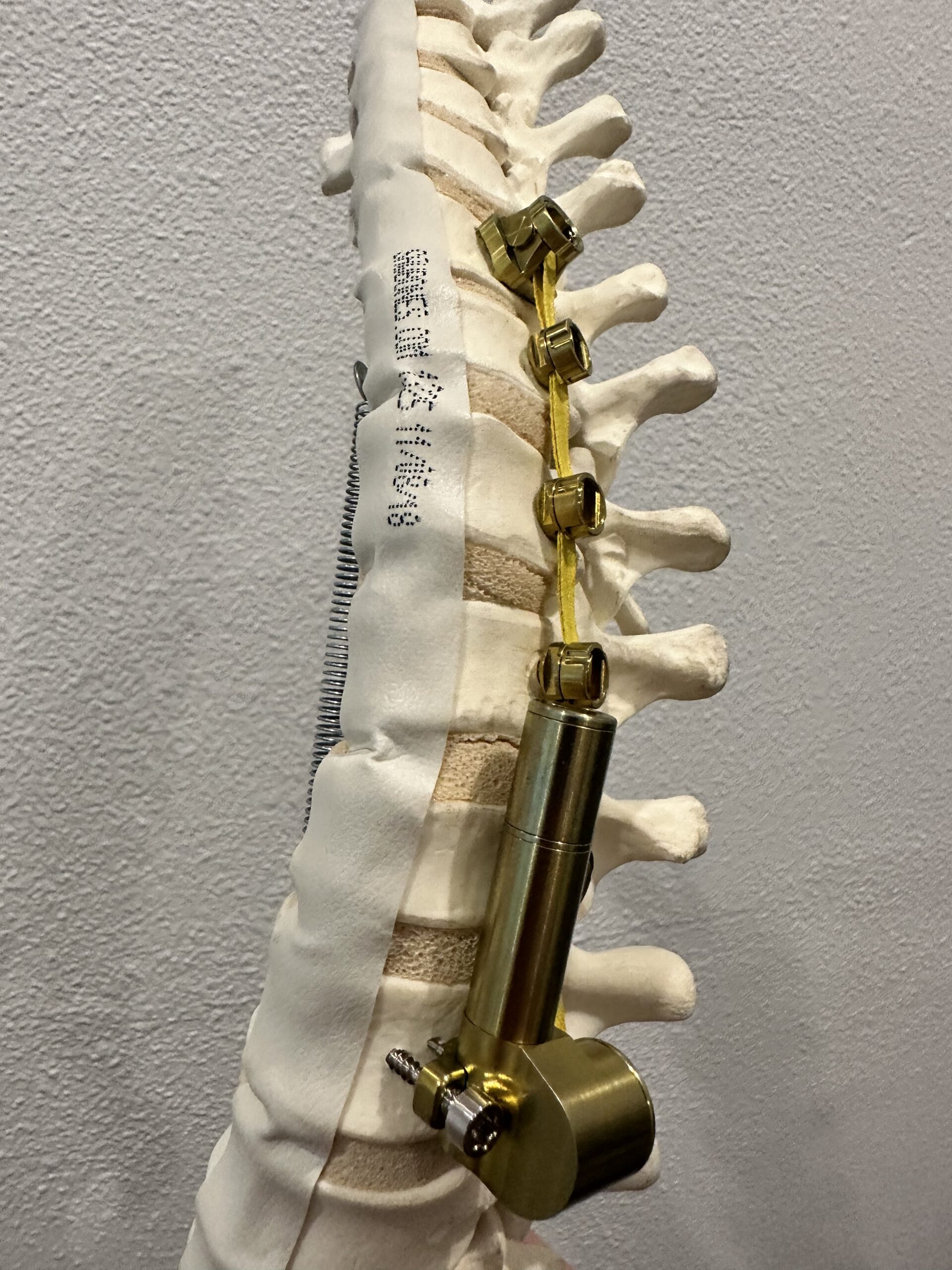
Unlike traditional spinal fusion, which permanently restricts mobility, Auctus Surgical’s Dynamic VBT (Vertebral Body Tethering) System offers a minimally invasive, non-fusion approach.
“Our mission is to provide a solution for AIS patients that keeps their spines mobile so they can continue competitive physical activities,” explained Murali Kadaba. “We also focus on a minimally invasive surgical approach for faster recovery, and non-invasive adjustments to personalize treatment based on each patient’s growth.”
The system has already been recognized with FDA Breakthrough Device Designation, a milestone that has accelerated interactions with regulators. “We’ve submitted five pre-subs with the FDA and received their feedback on our bench testing protocols, pre-clinical protocol, and pivotal clinical trial protocol,” said Kadaba. “The FDA has been very supportive of our work.”
The standout feature of Auctus Surgical’s system is its ability to be adjusted non-invasively using magnetic technology.
“With every scoliosis patient, routine follow-ups are needed to monitor progress,” explained Shulock. “During these visits, the physician can use Auctus Surgical’s external magnetic controller placed on the patient’s back. This controller generates a rotating magnetic field, which couples with a magnet in the implant to either increase or decrease tether tension. It allows doctors to fine-tune the straightening of the spine as each child grows.”
Developing such a system has come with challenges. “The main hurdles were optimizing the magnetic adjustment features and designing for minimally invasive implantation using thoracoscopic approaches,” said Kadaba.
Despite these challenges, the reception from surgeons has been positive. “Doctors are actively looking for a better solution for their patients,” noted Ashley. “They are not satisfied with fusion, and they see our Dynamic Tethering System as being tailored to provide a better solution. Of course, clinical outcome data will be the ultimate proof.”
Auctus Surgical envisions scoliosis care evolving rapidly. “We anticipate that in the next ten years, most scoliosis patients will receive non-fusion solutions,” said Ashley. “We plan to be the leader of that transformation.”
The team’s immediate focus is on completing design verification and validation of the Dynamic Tethering System.
As part of this journey, Auctus Surgical will present at MedTech Malta 2025. For Ashley, the event represents an important opportunity: “I am interested in the international exposure of this event,” he said.
The company’s goals are clear. “Our primary interest lies in investor and clinical collaborations,” added Kadaba. “We want to expand our investor reach and build international clinical contacts to support both early clinical work and future market development.”
With its motion-preserving approach and a leadership team experienced in advancing spine technologies, Auctus Surgical aims to offer a new option in scoliosis treatment.
Auctus Surgical’s work reflects the type of forward-looking innovation that continues to advance the MedTech sector. Meet Auctus Surgical and other pioneering companies at MedTech Malta 2025 (12–14 November), where global leaders, startups, investors, and healthcare providers gather to exchange ideas and build collaborations.
For more information about sponsorship, speaking, or pitching opportunities, contact us at [email protected].