Convention and Exhibition Centre (HKCEC), Hong Kong

Plan Your Trip | MedTech World Asia

August 26-28th, 2026

Enjoy Discounted Rates from Our Official Conference Hotel

Reserve now and benefit from exclusive discounted rates.

Grand Hyatt
Rating ImageRating ImageRating ImageRating ImageRating Image
The Park Lane Hong Kong, Autograph Collection
Rating ImageRating ImageRating ImageRating ImageRating Image

Come for the summit. Stay for the city. 

MedTech World Asia 2026 takes place at the Hong Kong Convention and Exhibition Centre (HKCEC), one of Asia’s most iconic venues, right on the waterfront of Victoria Harbour. Whether this is your first visit to Hong Kong or a return trip, this page has everything you need to plan a smooth, productive, and memorable stay.

Travel Guidelines

Getting to and around Hong Kong is straightforward, with one of the world’s most efficient public transport networks at your disposal. Here’s how to make every journey effortless.

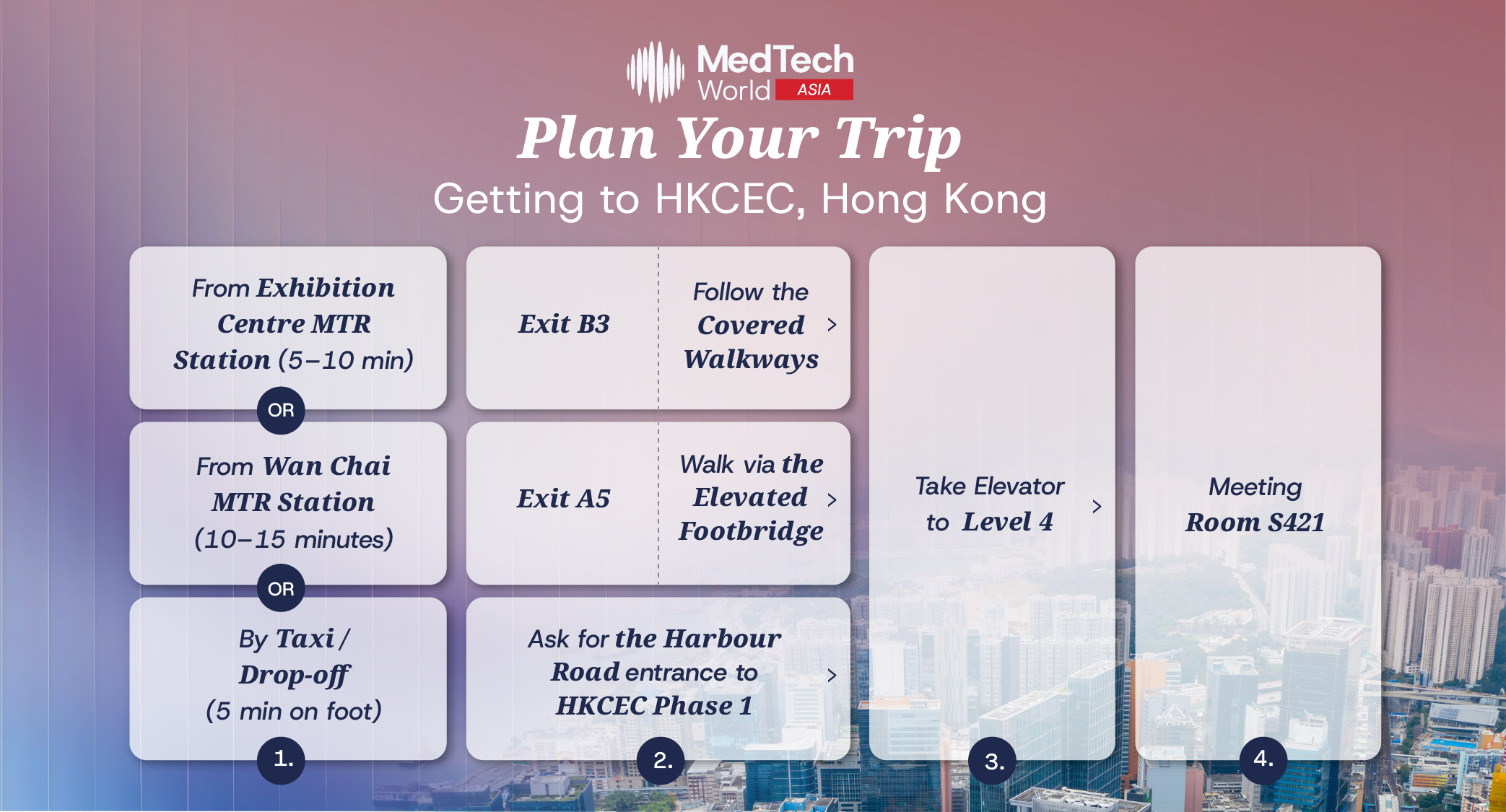
Getting to the Venue 

Hong Kong International Airport (HKG) is approximately 30-40 minutes from HKCEC, depending on your mode of transport.

Weather & What to Pack

August in Hong Kong: hot, humid, and occasionally dramatic. Late August sits squarely in Hong Kong’s summer, so expect temperatures between 28°C and 33°C with high humidity. Typhoon season runs from May to November, though direct hits during any given week are uncommon. Brief, heavy tropical downpours are more typical and can arrive with little warning. Light, breathable clothing — cotton and linen are your best friends. Loose-fitting fabrics that wick moisture will keep you comfortable outdoors and in the humidity. A layer for indoors — air conditioning in Hong Kong venues, hotels, and restaurants is often set very cold. A light jacket or cardigan in your bag is essential. Compact umbrella or packable rain jacket — summer showers can be sudden and heavy. A fold-up umbrella fits easily in a conference bag. Comfortable walking shoes — Hong Kong is a walkable city with plenty of steps, slopes, and escalators. Comfortable footwear will serve you far better than anything formal. High-factor sunscreen — the combination of sun and humidity intensifies UV exposure. SPF 50+ is recommended. Sunglasses and a hat — useful for outdoor sightseeing and travel between venues. Dress code at summit events: Business casual is standard across conference sessions and networking events. Some evening functions — including the Awards ceremony — may specify smart business attire. Please refer to the event agenda for details.

General FAQs

Hong Kong operates its own visa policy, separate from mainland China. Citizens of over 170 countries and territories — including the EU, UK, USA, Canada, and Australia — can enter visa-free for periods ranging from 14 to 180 days. Check the official Hong Kong Immigration Department website for the most up-to-date requirements for your nationality. Important: If you plan to cross into mainland China during your trip, you will need a separate China visa (unless you hold a passport eligible for the 240-hour transit exemption). Please check current requirements with the relevant authorities before travel.

The Hong Kong Dollar (HKD) is the official currency.

  • Credit and debit cards (Visa, Mastercard, Amex) are widely accepted at hotels, restaurants, and shops. 
  • Octopus Card — a rechargeable stored-value card — is the most practical way to pay for transport and small purchases. Available at MTR stations from arrival. 
  • Cash is useful for street markets, taxis, and smaller local eateries. ATMs are widely available; use those inside banks or shopping malls for security. 
  • Notify your bank before travelling to avoid overseas transaction blocks. 
No vaccinations are mandatory for entry to Hong Kong. However, the following are generally recommended, especially for international travellers: 
  • Routine vaccinations (MMR, tetanus, flu) — ensure these are up to date. 
  • Hepatitis A and B are advisable for travellers to Asia as a general precaution. 
  • Japanese Encephalitis is a low risk in urban Hong Kong but worth discussing with your doctor if you plan rural travel elsewhere in Asia. 
Always consult your healthcare provider or travel medicine specialist for personal advice well in advance of your trip. 
Hong Kong uses Type G plugs, the three-pronged rectangular-pin variety widely used in the UK, Ireland, and many Commonwealth countries. The voltage is 220–240V, 50Hz. 
  • UK travellers: your plugs will work directly. 
  • US, European, and most other travellers: bring a Type G travel adaptor. 
  • Most hotels provide adaptors on request, but it’s safer to pack your own. 
Hong Kong is consistently ranked among the safest cities in Asia for travellers. Violent crime is rare and the city is well-policed. As with any major international city, normal precautions apply: 
  • Keep an eye on your belongings in crowded areas such as markets and public transport. 
  • Use official taxis or registered ride-hailing apps; never accept rides from unlicensed drivers. 
  • Carry a copy of your passport/travel documents separately from the originals. 
Emergency number: 999 — for police, fire, and ambulance.  Non-emergency police enquiries: 2527 7177 
Yes, complimentary WiFi is available throughout the venue for all registered delegates and exhibitors. Network details will be provided in your delegate pack and via the event app. For reliable connectivity throughout your stay, consider purchasing a local SIM card or activating an eSIM on arrival. As all operators require ID to activate SIM cards, it is recommended to use a downloadable travel eSIM provider. MedTech World is partnered with ESIMATIC and provides discounts for delegates who download it.
  • Emergency services (police, fire, ambulance): 999 
  • Non-emergency police: 2527 7177 
  • Queen Mary Hospital (major public hospital): 2255 3838 
  • The MedTech World team will also be on hand throughout the summit. Event support is available from 8:00 AM on all event days. 

Hong Kong City Guide

Many delegates make the most of the trip by arriving early or staying on a few extra days, and Hong Kong is very much worth it. Here are the highlights.

Victoria Peak: The city’s most famous viewpoint, the Peak offers sweeping panoramas over Hong Kong Island, Victoria Harbour, and Kowloon. Take the historic Peak Tram up and linger at sunset or after dark when the skyline transforms into a sea of light. A must.  Tsim Sha Tsui Promenade: Stretching along the Kowloon waterfront, the TST promenade is ideal for an evening stroll after the conference. Enjoy the full Hong Kong Island skyline from across the harbour — and don’t miss the Symphony of Lights show at 8pm.  Star Ferry: One of the world’s great short journeys. The 10-minute crossing between Central Pier and Tsim Sha Tsui costs pennies and offers views money can’t buy. Do it at least once.  Central & Sheung Wan: The heart of Hong Kong’s commercial district is also home to galleries, heritage buildings, independent coffee shops, and excellent restaurants. PMQ, the converted former police quarters, is a great spot for design, food, and culture.  SoHo & Lan Kwai Fong: Just uphill from Central, SoHo (South of Hollywood Road) is the city’s most vibrant dining and bar neighbourhood. From casual noodle shops to international fine dining, it’s the natural choice for post-conference dinners with delegates and partners. Lan Kwai Fong, adjacent, is the go-to for drinks.  Mong Kok & Temple Street Night Market: Cross the harbour to Kowloon for a completely different pace. Mong Kok’s dense, buzzing streets are quintessential Hong Kong, with electronics, fashion, and street food markets. The Temple Street Night Market comes alive after dark with food stalls, street performers, and fortune tellers.  M+ Museum: Located in the West Kowloon Cultural District, M+ is one of Asia’s most significant museums of contemporary visual culture, showcasing art, architecture, design, and film. Perfect for delegates who want culture beyond the conference halls.  Man Mo Temple: One of Hong Kong’s oldest temples, tucked into a bustling street in Sheung Wan. The incense-filled interior and traditional architecture offer a striking contrast to the surrounding city.  Lantau Island:  About an hour from the city, Lantau Island is home to the iconic Tian Tan Buddha, Po Lin Monastery, scenic hiking trails, and the Ngong Ping 360 cable car. A great full-day trip if you have time before or after the summit.  Lamma Island & Cheung Chau: For something slower, the outlying islands are just a short ferry ride away. Lamma Island is famous for its seafood restaurants and car-free lanes; Cheung Chau offers beaches, a lively town, and traditional fishing village life.
Hong Kong is one of the world’s great food cities, with a density of restaurants, diversity of cuisine, and quality of ingredients that is hard to match anywhere. Here’s a taste of what to expect: 
  • Dim Sum — the definitive Hong Kong meal. Steamed shrimp dumplings (har gow), pork siu mai, barbecue pork buns, and rice noodle rolls served from bamboo steamers. Best enjoyed as a long, leisurely weekend breakfast (yum cha). 
  • Cantonese Roast Meats — char siu (barbecue pork), crispy roast pork belly, soy chicken, and roast duck — served over rice or noodles, often from simple hole-in-the-wall shops that have been doing it for decades. 
  • Fresh Seafood — Hong Kong’s proximity to the South China Sea means exceptional seafood, from live seafood restaurants in Sai Kung to casual dai pai dong stalls. 
  • Wonton Noodle Soup — thin egg noodles in a clear broth with plump, handmade prawn wontons. A Hong Kong soul food classic. 
  • Hong Kong Milk Tea & Egg Tarts — smooth, silky tea brewed from a blend of Ceylon leaves and evaporated milk, often paired with a freshly baked egg tart or pineapple bun. The definitive local café experience (cha chaan teng). 
  • Street Snacks — egg waffles (gai daan jai), curry fish balls on skewers, and stinky tofu from night market stalls. 
  • International Fine Dining — Hong Kong has more Michelin stars per square kilometre than almost any city in the world. French, Japanese, and Modern Asian restaurants of the highest calibre are concentrated in Central and Kowloon. 
  Local tip: Some of the best food in Hong Kong comes from no-frills, cash-only local restaurants (dai pai dong) and street stalls, so don’t walk past them in search of something fancier.