- Summits
- Sponsorship
- Retreats
- Media Opportunities
- News
- About
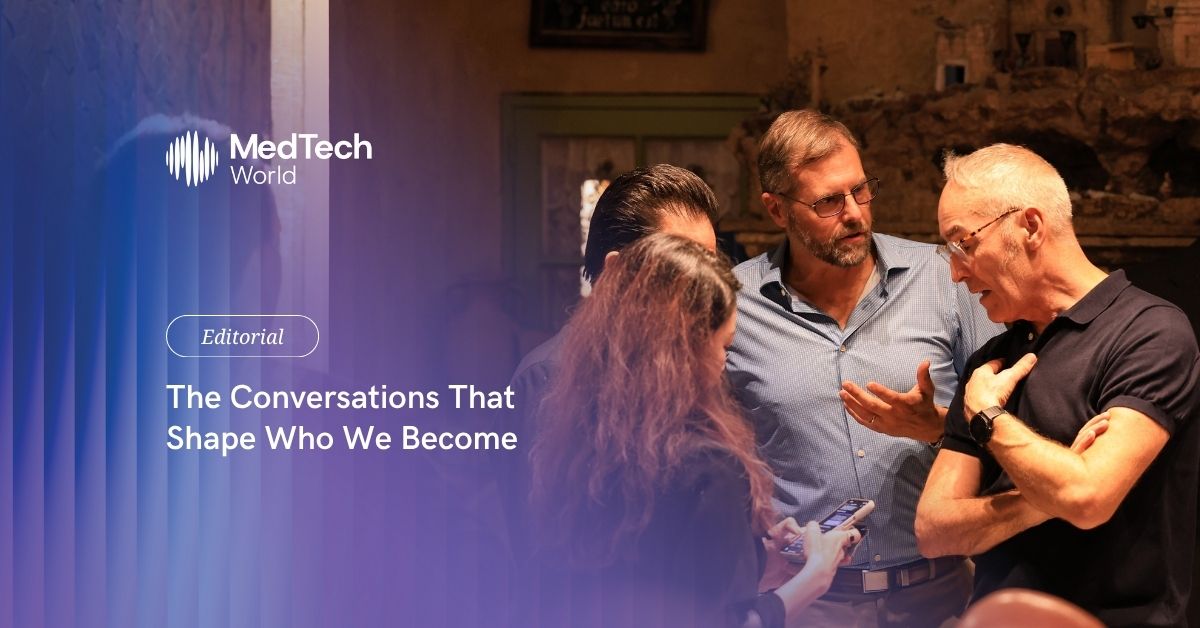
The best teams don’t just work together, they grow together.
Dan Martell recently shared a line that’s been echoing in my mind ever since:
“The person you’ll be in 5 years depends on:
The books you read
The people you spend time with
The food you eat
The habits you adopt
The conversations you engage in today.”
That last one, the conversations you engage in, is what truly defines great teams and great careers.
Throughout my career leading MedTech innovation teams, I’ve made it a point to hold regular 1:1s with every team member, not just as check-ins, but as co-development sessions.
Each conversation ends the same way:
They have action items, and so do I.
Both of us are accountable to each other.
That two-way commitment builds trust, the kind that transforms a team from simply delivering tasks to delivering transformation.
It’s never about micromanagement; it’s about mutual ownership.
When both leader and contributor are learning, adapting, and holding each other to a higher standard, growth stops being a directive, it becomes a habit.
One of the small but powerful traditions I’ve encouraged across my teams is to add at least two new skills or experiences to your résumé each year.
It doesn’t matter whether it’s a new tool, a new domain, or a stretch project outside your comfort zone, what matters is the momentum.
When we intentionally keep learning, we stay adaptable.
And in MedTech, where innovation moves fast and regulation keeps us grounded, adaptability is the ultimate competitive advantage.
In recent years, my own curiosity has centered around the incredible potential of large language models (LLMs) and AI augmentation.
I began sharing not just articles or theory, but real prompts and real results with my teams, the successes and the failures alike.
Sometimes, the outputs were astonishing.
Other times, they missed the mark entirely.
But every experiment taught us something valuable: how to ask better questions, refine our thinking, and push the edge of what was possible.
Those discussions often sparked deeper curiosity.
Team members would come back with their own experiments, insights, and applications, everything from automating documentation reviews to exploring risk-management summaries that read like they were written by an expert auditor.
It became less about “using AI” and more about learning how to learn again, together.
In our field, innovation isn’t optional, it’s survival.
Regulations evolve, technologies shift, and the devices we design today are built on the insights we’ll gain tomorrow.
That’s why the most important skill any MedTech professional can cultivate is the discipline of continuous learning, paired with the humility to share both the wins and the failures.
Because the truth is, breakthroughs rarely happen in isolation.
They happen when curious people exchange ideas, test assumptions, and lift each other higher through shared discovery.
As I step into this next chapter of my career, as a consultant, trainer, and coach helping MedTech teams harness AI as an ally, my mission is simple:
The future of MedTech belongs to the teams who remain curious, accountable, and connected.
The ones who keep feeding their curious souls, not because they have to, but because they can’t imagine doing anything else.
Five years from now, I want to look back and say: These were the conversations that shaped who we became, and what we built together.
Join us at MedTech Malta 2025, taking place on 12–14 November 2025 at the Mediterranean Conference Centre, Valletta. Experience three days of networking, thought-provoking discussions, and collaborations that move healthcare innovation forward.
Claim your spot today and take part in the dialogue that matters!