- Summits
- Sponsorship
- Retreats
- Media Opportunities
- News
- About
Startup. Scaleup. Company.
Three simple words that carry a lot of weight—and confusion.
Ask ten founders where the line is, and you’ll hear twelve opinions. Ask a VC or acquirer, and you’ll get a spreadsheet.
The truth sits somewhere in between: how you define yourself shapes how you hire, raise, sell, and scale.
Steve Blank’s definition still nails it: a startup is a temporary organization searching for a repeatable, scalable business model.
You’re in “search mode” if your days are filled with hypotheses—about markets, clinical claims, pricing, and reimbursement—and you’re still testing more than you’re executing.
In MedTech, that means need finding, early prototypes, and regulatory pathway exploration. You can have a QMS and still be in startup mode if every big win still depends on founder heroics.
A scaleup is what happens after the search works. The OECD and ScaleUp Institute define it as 20 percent+ growth for three consecutive years—a rough proxy for repeatable traction.
In MedTech, the translation is simple: you’ve cleared your product, proven economic value, and can now train a rep to deliver the same result without rewriting the playbook.
The systems that carry growth—supply chain, quality, sales ops—start to matter as much as the invention itself.
Being a company isn’t about size; it’s about operational maturity.
You’ve built a predictable engine—strong margins, solid quality systems, layered leadership, and reliable forecasting.
You can step away for a month and the train still runs.
At that point, innovation doesn’t stop—but process and discipline become your true differentiators.
Founders often cling to “startup” far longer than investors think they should.
And it’s not denial—it’s strategy.
In MedTech, the opposite sometimes applies.
When selling to hospitals or strategic partners, “startup” can sound like supplier risk.
Many teams rebrand as a “commercial-stage MedTech company” long before they technically fit the scaleup mold.
VCs think in risk-return curves. They’ll call you a startup until the growth model repeats on its own.
Once it does, you’re a scaleup—until the risk profile shifts from “prove it” to “keep it efficient.”
Strategic buyers think in integration risk.
They’ll call you a startup if value depends on people or tacit know-how, a scaleup if your growth systems are portable, and a company if diligence shows a durable engine they can plug in without founder dependency.
Same operating reality, three different narratives—each rational from their side of the table.
A startup isn’t defined by newness or headcount—it’s defined by scalable intent.
If growth relies on linear headcount or local capacity, you’re running a small business (a perfectly honorable path).
In MedTech, that’s often the distinction between a consultancy with an R&D asset and a venture building a repeatable product business.
Think of these not as boxes you graduate through, but modes you shift between:
Startup → search and learn
Scaleup → prove and repeat
Company → optimize and endure
You can run startup-style experiments inside a company, or company-grade quality systems inside a startup. The edges blur—and that’s okay.
“We work like a startup—fast, owner-led—but we’ve found product-market fit in [your niche]. You’ll own real territory.”
“We’re a commercial-stage MedTech company with regulatory clearance, post-market processes, and established purchasing pathways.”
“We’ve found product-market fit and are entering scale mode—playbooked GTM, expanding team, and 20%+ growth trajectory.”
“We operate as a scaleup-grade company—repeatable growth, audited QMS, and minimal key-person risk.”
If your answers cluster mostly in one column, that’s your current mode.
Label yourself accordingly—and speak that language to the audience that matters next.
Founders define themselves by intent and culture.
Investors and acquirers define you by evidence and risk.
The smartest MedTech leaders learn to speak both dialects fluently.
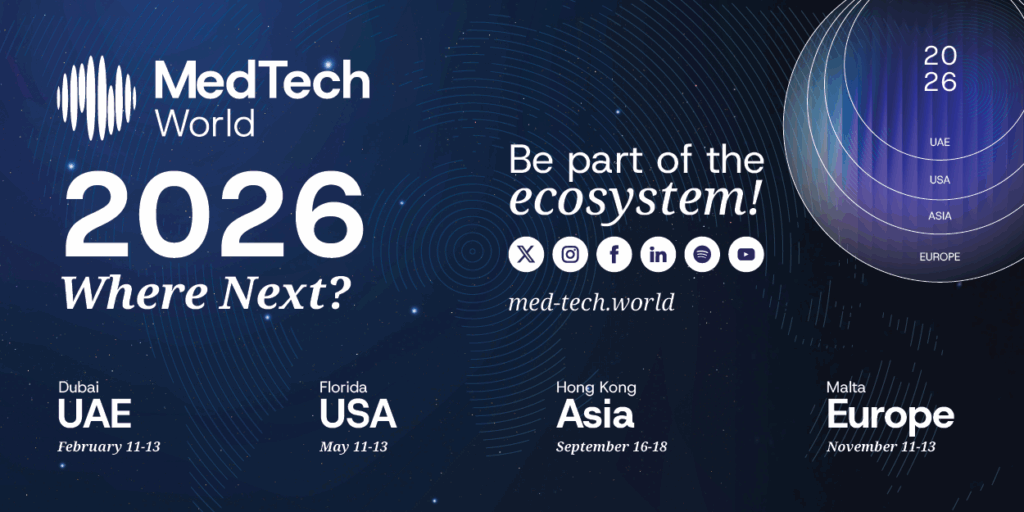
Whether you’re a startup in search mode, a scaleup building repeatability, or a company operating with full commercial maturity, the next stage of your journey deserves the right platform. MedTech World’s four flagship events in 2026 bring together global founders, investors, clinicians, and strategics to help you connect, learn, and accelerate your mission.
Join us across Dubai, West Palm Beach (Florida), Hong Kong, and Malta—four hubs that reflect where MedTech momentum is rising fastest.
Wherever you are in your lifecycle, there’s a stage for you at MedTech World 2026.