- Summits
- Sponsorship
- Media Opportunities
- News
- About
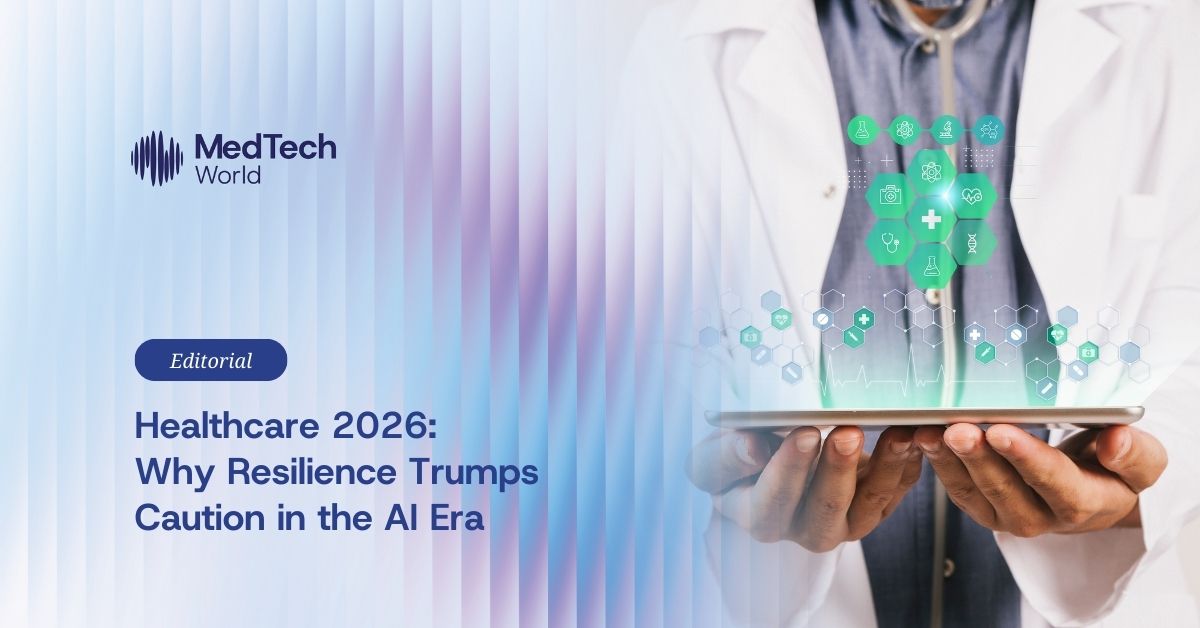
The pace of AI transformation is reshaping healthcare faster than regulatory frameworks can adapt. After 30 years in medtech product development, I’ve never seen an innovation cycle move this fast—or separate winners from losers this decisively.
In the three years since ChatGPT launched, we’ve witnessed a shift that typically takes a decade. Automation that once required chaotic coding marathons now flows from conversational AI tools. The medtech executives I work with in my biweekly roundtable are experiencing this firsthand: teams that couldn’t automate basic workflows six months ago are now building sophisticated systems in days.
Yet according to Deloitte’s 2026 Life Sciences Outlook Survey, 73% of biopharma and medtech leaders express confidence in their own organizations, but only 41% feel optimistic about the global economy’s health. This disconnect reveals something important: companies know they need to act, but they’re unclear on which direction to move.
The data tells a more nuanced story. While non-US executives show 56% positivity about 2026 (compared to 50% for US-based leaders), medtech overall demonstrates stronger optimism at 84% versus biopharma’s 78%. The divergence makes sense—medtech companies tend to have clearer line-of-sight to product-market fit and shorter regulatory pathways than their pharma counterparts.
Deloitte’s survey identified the top five trends shaping organizational strategy in 2026. Regulatory changes jumped to the number one concern at 51%—a 15-point increase from 2025’s 36%. Accelerated digital transformation came in second at 48%, up from 34% the previous year. Rounding out the top five are pricing and access pressures (44%), geopolitical and economic uncertainty (39%, a striking 20-point jump), and connected care delivery models (33%).
But here’s what the survey doesn’t capture: the gulf between teams treating AI as a cost line versus those seeing it as a capability multiplier.
I’ve watched this play out repeatedly. Companies viewing AI as an expense question every implementation. Those treating it as an investment in their teams’ capacity see immediate returns. It’s the difference between asking “How much will this cost?” versus “How much faster can we move?”
The pressure points cluster around three interconnected areas: R&D efficiency, speed-to-market, and regulatory complexity.
Medtech companies prioritize deploying AI tools for operational efficiency at 47% versus biopharma’s 31%. Meanwhile, 41% of biopharma executives focus on improving R&D productivity compared to 39% of medtech leaders. These aren’t dramatically different numbers, but they reveal where each sector feels the squeeze.
Here’s the opportunity most companies miss: regulatory documentation. The regulatory domain duplicates activities endlessly. It’s perfectly suited for AI-powered templates that learn your processes and formats. You input new information; the system handles the documentation structure. This isn’t about cutting corners—it’s about accelerating time-to-market without introducing additional risk.
Of course, the better solution would be simplifying those regulatory complexities. Until that happens, smart companies automate the mundane work, keeping their team-members actively in the loop, thus freeing their experts to focus on genuine innovation.
Speaking of regulation, I see a lot of regulatory teams in hair-on-fire mode over the newAI requirements. The reality? The FDA’s guidance for embedded machine learning or AI in 510(k) submissions asks for one new thing: a roadmap showing how you’ll manage change over time.
We’ve been doing this for software development under IEC 62304 for years. We just didn’t always have to submit it before. So while many regulatory departments claim the sky is falling, I see this as business as usual with slightly more paperwork.
This matters because fear-based decision-making around regulation creates drag on innovation. Companies that understand these requirements as extensions of existing practices move forward confidently. Those treating them as existential threats slow down unnecessarily.
The European AI Act takes a more human-centric approach than US frameworks, particularly around transparency and accountability. I think this is positive. If your product enters European markets, you’ll need to conform to these guidelines anyway. Companies that embrace human-centered AI design early will have competitive advantages in multiple markets.
Both the Deloitte survey and Nelson Advisors’ IPO predictions emphasize resilience as organizations navigate uncertainty. But resilience isn’t achieved through caution—it’s built through practice.
As companies grow larger, they tend to become more risk-averse. They reward not taking risks, which atrophies the resilience muscle. In product development, I consistently see larger organizations being too conservative. Some fraction of every budget must fund the innovation side of the business, or you become obsolete.
This is where the IPO market dynamics become fascinating. Nelson Advisors predicts 2026 will mark “The Return of the Mega-Deal,” with large healthcare IPOs like Zelis Healthcare (projected at $1B+ valuation) and potential Medtronic MiniMed spin-offs entering the market. Companies demonstrating measurable AI ROI are particularly attractive.
But here’s the challenge: after an IPO, public scrutiny intensifies dramatically. I’ve been in startups that went public, then bought themselves back private—twice—because managing investors while managing the business proved nearly impossible.
Amazon cracked this code by telling investors upfront: “We’re going to waste this big chunk of change every year trying innovative things.” As long as they manage both the business and the narrative, it works. In medtech, I haven’t seen anyone successfully balance both. Most bigger companies avoid any scent of risk, which tamps innovation down and they just repeat what worked last year and wonder why their performance is lagging that of their “worthy rivals”.
Here’s where I diverge from mainstream thinking. With both Anthropic and OpenAI releasing healthcare-specific AI applications, there’s an assumption that healthcare data will flow freely between providers, creating this unified ecosystem where everyone shares information seamlessly.
I don’t see it happening.
This was optional in the Obama administration’s Affordable Care Act, and it remained optional for a reason. Companies like Epic don’t want to release their data to other providers if they don’t have to. Epic maintains a single database they don’t want corrupted or exposed. With no mandatory requirement, why would they change?
So if you’re building products assuming healthcare becomes this big unified environment where data flows onto phones and everyone’s happy, I think that’s a pipe dream that is unlikely to happen in our lifetimes unless incentives change.
This matters for product development strategy. Build for the fragmented reality, not the idealized future. Create value within existing constraints rather than waiting for infrastructure that may never materialize.
Companies not using AI in their development processes and daily operations will be bypassed by startups and competitors who do. This isn’t hypothetical. I’m watching it happen in real-time.
In 2025 alone, we’ve moved from chaotic AI experimentation to sophisticated automation using tools like Claude Code. The teams I work with in my biweekly executive roundtable are experiencing radical capability increases with the same headcount and hours in the day.
The startups entering the IPO pipeline understand this. According to Nelson Advisors’ watchlist, companies like Sword Health (digital MSK care, $4B valuation) and Maven Clinic (women’s and family health, $1.7B valuation) are positioning for liquidity events precisely because they’ve integrated AI into their operational DNA.
Meanwhile, established companies debate whether AI is worth the investment.
If you’re a CEO, you must use AI tools publicly and share both successes and failures with your team. This isn’t about perfection—it’s about demonstrating that experimentation is valued.
For executives facing organizational inertia, bring in someone who knows your business cold and knows how to manage AI transition. This person should guide your teams as an active participant, not a consultant who creates dependency. The goal is building internal capability that continues after the engagement ends.
Think about it like professional sports. Every high-performing team has coaches. Not because the players lack talent, but because coaching accelerates development and helps teams reach potential they couldn’t achieve alone. Even Steve Jobs and Eric Schmidt had the same coach (read “Trillion Dollar Coach”).
You need a coach who’s hands-on, who actually knows how to implement these tools in your business, rather than just talking about them. Someone who will earn your team’s respect and help them accelerate beyond your wildest expectations.
This isn’t about transformation for transformation’s sake. It’s about making AI adoption a movement within your company, giving people the feeling they’re part of the revolution, not victims of it.
Deloitte’s research shows organizations are optimistic about their own prospects but cautious about the broader landscape. The IPO market is showing signs of life for companies with strong fundamentals and demonstrated AI capabilities. Regulatory requirements are evolving, but not as dramatically as headlines suggest.
The real question isn’t whether AI will transform healthcare, it already is. The question is whether your organization will be among those driving that transformation or scrambling to catch up.
After 30 years in this business and nine years working with machine learning and AI, I can tell you: resilience comes from action, not caution. The companies that will thrive in 2026 and beyond are those building that muscle now.
Deloitte: 2026 Life Sciences Outlook Survey
Nelson Advisors. “HealthTech, Digital Health, MedTech IPO Predictions 2026
This conversation will be explored further at MedTech World Middle East | Dubai 2026, taking place from 11–13 February at the Dubai InterContinental Festival City. One of the key sessions, “AI in Healthcare: From Hype to Hospital-Ready Solutions,” brings together industry leaders to move past theory and examine how AI is actually being implemented in clinical, operational, and regulatory settings. The panel will focus on what it takes to deploy AI responsibly, align teams, and translate capability into real-world impact, without losing sight of regulatory and human considerations. For leaders navigating AI adoption today, it’s a timely opportunity to engage in practical, experience-led discussion with peers facing similar challenges. Be part of the conversation now!