- Summits
- Sponsorship
- Retreats
- Media Opportunities
- News
- About
As MedTech startups look beyond traditional expansion markets such as the US and Europe, the UAE is increasingly emerging as a serious strategic option, not as a shortcut, but as a structured and pragmatic market that rewards preparation.
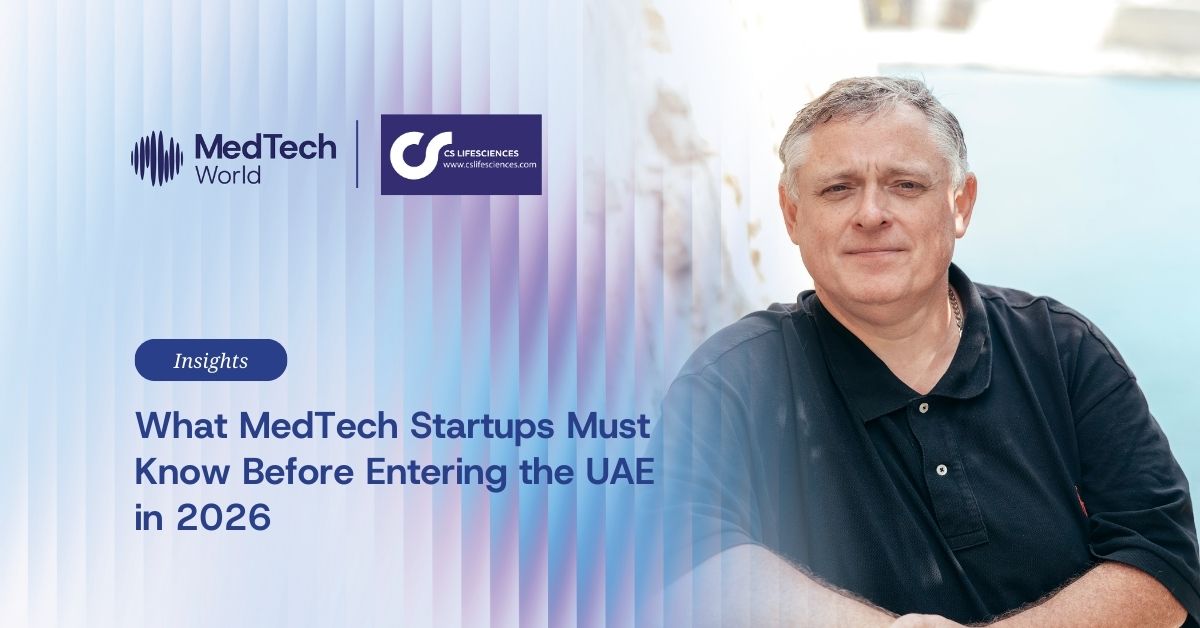
According to Edwin Lindsay, Managing Director and Principal Consultant at CS Lifesciences, the UAE offers something many early-stage companies struggle to find elsewhere: the ability to build meaningful clinical and commercial traction without requiring the scale, capital, or operational footprint demanded by the US or EU from day one.
“For a MedTech startup, it’s a place where you can build credible regional clinical and commercial traction early,” Lindsay explains. “It’s also an effective launchpad into the wider GCC, because success in the UAE carries weight with regional stakeholders and decision-makers.”
One of the first challenges startups face, Lindsay notes, is misunderstanding the UAE regulatory environment altogether.
“The biggest misconception is that the UAE is either easy or impossible,” he says. “In reality, it’s neither. It’s structured, increasingly professionalised, and pragmatic.”
A common assumption is that CE marking or FDA clearance guarantees fast approval. While those approvals are helpful, Lindsay cautions that they are only part of the equation. Local alignment on device classification, labelling, authorised representation, vigilance responsibilities, and how clinical and risk evidence is presented remains critical.
The UAE’s medical device framework continues to evolve, with a noticeable shift towards stronger post-market expectations and higher-quality documentation.
“As we move into 2026, there is less tolerance for informal fixes late in the process,” Lindsay says.
“Founders need a coherent technical file, a consistent quality management story, and claims that align across documentation from day one.”
Equally important is operational readiness. Post-market surveillance and vigilance are no longer box-ticking exercises. Regulators expect companies to demonstrate that these processes can be executed locally and consistently once products are on the market.
Many MedTech companies enter the UAE having already navigated EU MDR or FDA pathways. Lindsay believes this experience can be valuable—but only when applied with the right mindset.
“What translates well is disciplined documentation,” he explains.
“Strong risk management, a clear intended use, well-structured clinical evaluation, and robust QMS controls all support smoother submissions in the UAE.”
Where companies often struggle is assuming that the hardest work is already done. Local execution still matters. Gaps in labelling strategy, distributor oversight, authorised representation, or vigilance ownership can slow down approvals regardless of how strong the EU or US dossier may be.
Key lessons from MDR and FDA processes, Lindsay adds, include consistency of intended use and claims, treating design and risk files as strategic assets rather than compliance burdens, and developing a clear technical narrative early, one that can be adapted across markets rather than rewritten each time.
Some of the most consequential regulatory decisions are made long before a submission is filed.
“Getting classification and intended use right is critical,” Lindsay says. “If you inflate claims, you inflate evidence requirements and increase regulatory risk.”
Designing evidence generation and quality systems with international reuse in mind can prevent costly rework later. Early planning around labelling, IFUs, UDI expectations where applicable, and post-market processes also helps avoid last-minute delays.

When it comes to balancing speed-to-market with regulatory robustness, Lindsay is clear: shortcuts are rarely effective.
“Speed comes from clarity, not shortcuts,” he says. “The strongest teams define a minimum viable regulatory pathway that is fully defensible, and then commit to it.”
What slows teams down, he observes, is indecision. Keeping multiple regulatory options open, delaying claim decisions, or avoiding accountability creates friction rather than flexibility.
“Startups don’t need more options,” Lindsay adds. “They need someone accountable who can say: this is the pathway, this is the evidence we will stand behind, and this is what we won’t claim yet.”
While UAE approval is a strong foundation, GCC expansion requires careful planning.
“It’s not a copy-paste exercise,” Lindsay says. “You can reuse much of the technical file, but national requirements, local representation, importation rules, and post-market responsibilities still vary.”
Operational readiness often proves to be the limiting factor, particularly complaint handling, vigilance timelines, distributor oversight, and documentation control across partners.
Looking ahead, Lindsay sees a continued move toward stronger governance and post-market maturity across the UAE and GCC.
“Regulators are expecting clearer traceability, better alignment between claims and evidence, and real accountability once products are on the market,” he explains.
“It’s no longer enough to present systems on paper, you need to show that you can operate them regionally.”
Lindsay will be sharing these insights during the panel “Navigating Regulatory Pathways & Market Access Strategies for the MedTech” at MedTech World Middle East | Dubai 2026, taking place from 11 to 13 February 2026.
His goal is practical clarity. “Regulatory is not a barrier; it’s a strategy lever when done well,” he says.
“The Middle East isn’t one market, but it’s navigable if you plan sequencing properly, choose the right partners, and make disciplined early decisions.”
For startups targeting UAE entry within the next 12–18 months, Lindsay emphasises the importance of a clear target profile, a realistic submission plan, defined post-market responsibilities, and, above all, experienced decision-making governance.
“That’s how companies move forward with confidence instead of getting stuck in analysis paralysis,” he concludes.
Edwin Lindsay will explore these themes further during the panel “Navigating Regulatory Pathways & Market Access Strategies for the MedTech” at MedTech World Middle East | Dubai 2026, taking place from 11 to 13 February 2026.
The session will offer an opportunity to engage in informed discussions with regulatory experts and industry peers on how MedTech companies can approach UAE and GCC market entry with clarity and confidence.
Join the conversation at MedTech World Middle East | Dubai 2026 and book your tickets now to be part of these critical regulatory discussions.