- Summits
- Sponsorship
- Media Opportunities
- News
- About
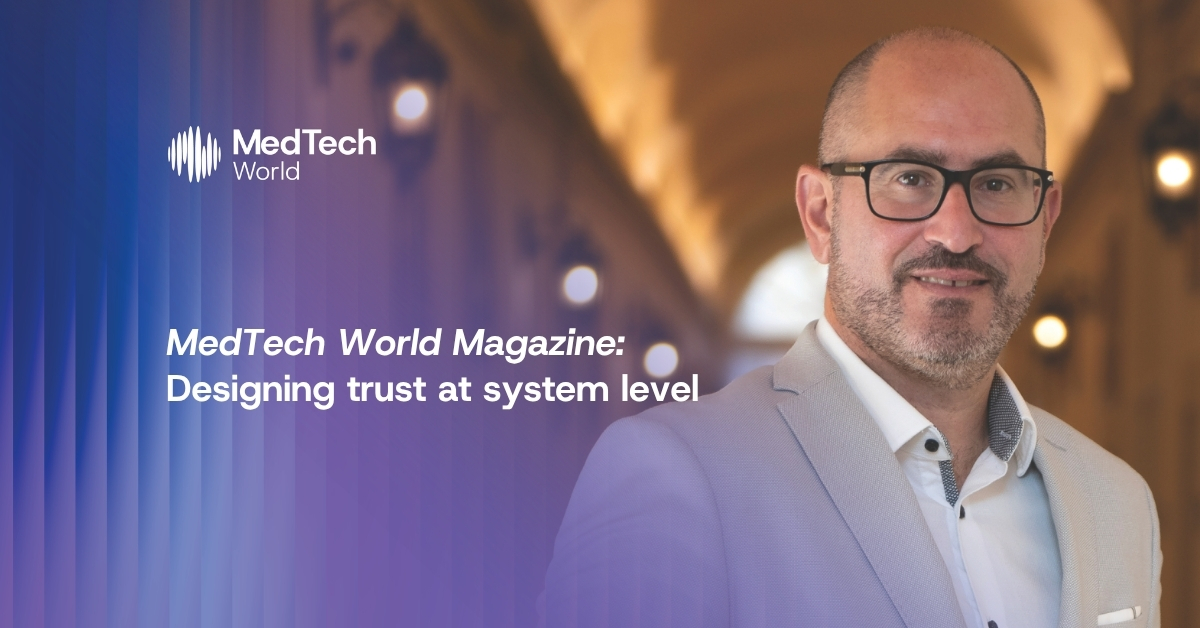
In conversations about healthcare innovation, MedTech is often framed as a race to build better technology. Yet one of the sector’s most persistent challenges is not innovation itself, but integration: how to introduce new tools into public health systems that are complex, highly regulated, and accountable to citizens. This is the space where Kenneth Brincat, CEO of the Malta Digital Innovation Authority (MDIA), has focused his work, treating regulation not as a constraint, but as a foundational enabler of sustainable innovation.
Rather than competing on scale, Malta has chosen to compete on structure. Its approach is built on the premise that innovation in sensitive sectors like healthcare cannot be detached from governance, trust, and institutional readiness. Under Brincat’s leadership, the MDIA operates at the intersection of these forces, combining regulatory oversight with hands-on support for startups, research institutions, and public bodies. The goal, as he describes it, is to create an ecosystem “where technology can thrive responsibly,” without forcing innovators to choose between speed and safety.
A central pillar of this strategy is DiHubMT, Malta’s European Digital Innovation Hub. Designed around a “test before you invest” philosophy, the hub provides startups and SMEs with access to advanced technologies, regulatory guidance, and validation environments before they face the pressures of market deployment. High-performance computing infrastructure plays a key role, transforming data into actionable insight for research and product development. Programs such as the Startup Launchpad further reinforce this approach by helping early-stage teams validate problem-solution fit before incorporation, reducing both technical and regulatory risk.
Artificial intelligence is where this model is being tested most visibly. In healthcare, AI directly influences clinical decisions, patient safety, and professional accountability. With the introduction of the EU AI Act, Malta has positioned itself at the forefront of responsible AI implementation, designating the MDIA as the Market Surveillance Authority. Brincat emphasizes that compliance alone is not enough. What matters is creating pathways that allow innovators to experiment safely while aligning with legal and ethical standards from the outset.
This is where the MDIA’s regulatory sandbox becomes critical. By offering a controlled environment for testing AI systems, including those used in MedTech, the sandbox enables developers to validate solutions before large-scale deployment. “Access to guidance and advisory support is just as important as access to advanced technologies,” Brincat notes, highlighting the Authority’s role in aligning innovation with international best practices such as the OECD and UNESCO AI ethics frameworks. Complementary tools, including the AI Helpdesk and self-assessment guides under the EU AI Act, are designed to reduce uncertainty and help companies navigate complex regulatory terrain.
Crucially, Malta’s approach treats regulation as infrastructure. In a landscape where AI-powered medical devices are classified as high-risk systems, clarity and predictability become strategic advantages. The MDIA’s close coordination with the Medicines Authority ensures alignment between the AI Act, the Medical Device Regulation (MDR), and the In Vitro Diagnostic Regulation (IVDR), simplifying compliance without diluting standards. This integrated oversight model reflects a broader shift, from regulation as a gatekeeper to regulation as a system that enables safe scale.
Trust remains the underlying challenge. Even the most robust regulatory frameworks can falter if patients, clinicians, and the public lack understanding or confidence in new technologies. Brincat is explicit about this risk, pointing to transparency and communication as essential tools for addressing ethical concerns and public resistance. Equally complex is stakeholder coordination, which means aligning regulators, innovators, healthcare providers, and policymakers who often operate on different timelines and incentives.
Looking ahead, Malta’s ambition is not to become a closed innovation hub, but a connective one. Initiatives such as CALYPSO, the AI Factory Antenna linked to Greece’s PHAROS supercomputer, reinforce Malta’s role within the wider European AI ecosystem. Healthcare is one of the priority sectors, enabling access to infrastructure, datasets, and expertise that support the development of trustworthy, scalable MedTech solutions.
Ultimately, the MDIA’s contribution under Brincat’s leadership lies in cementing Malta’s position as a centre for excellence by making complex technological innovation workable and secure for the wider market. At a time when technology is advancing faster than institutions can adapt, Malta offers a different perspective: in healthcare, progress depends less on disruption and more on building the regulatory and ethical foundations that allow innovation to endure.
Get featured in MedTech World Magazine, a curated publication for senior decision-makers across the global MedTech ecosystem. Distributed at MedTech World’s flagship events, each edition extends on-stage conversations into practical industry insight.
Read this edition, or apply to be featured.
From 9 to 13 November, the global MedTech ecosystem will gather in Malta for an expanded five-day experience that combines the inaugural Investors Retreat in Gozo (9-11 November), a cultural immersion programme (11 November), and the flagship MedTech World Europe conference (12-13 November) at the Mediterranean Conference Centre in Valletta. Bringing together founders, investors, healthcare leaders, regulators, and innovators, the event offers opportunities for networking, knowledge exchange, startup showcases, investor meetings, and the MedTech World Awards. Learn more and secure your place at MedTech World Europe 2026.