- Summits
- Sponsorship
- Retreats
- Media Opportunities
- News
- About
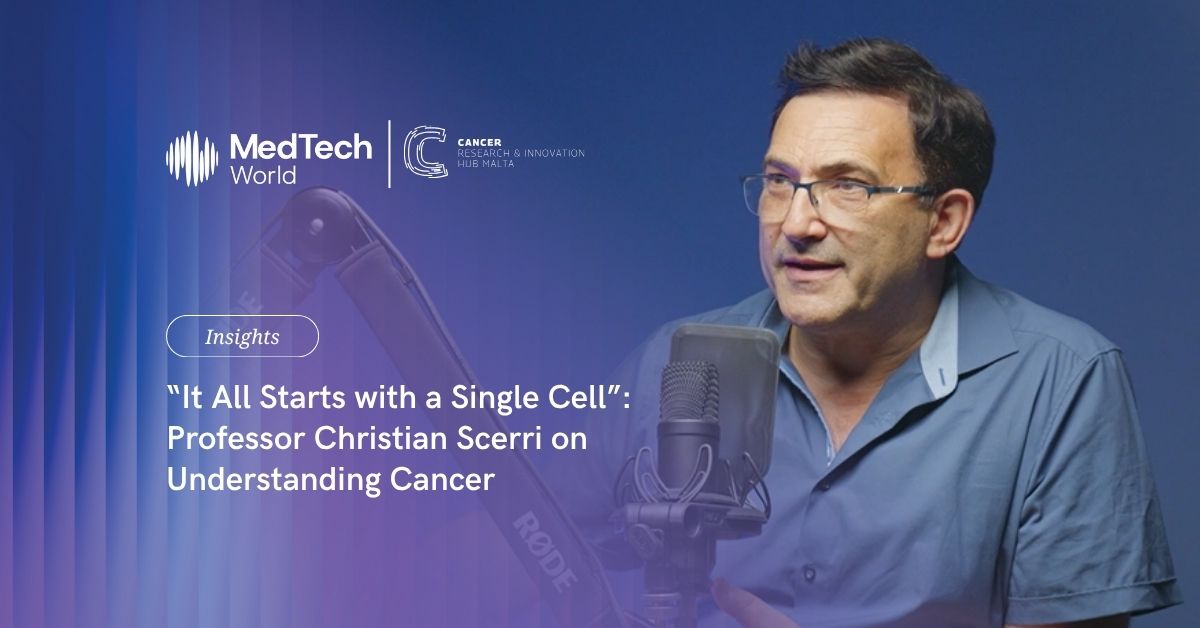
MedTech World interacted with Professor Christian Scerri, Chair of the Cancer Research and Innovation Hub Malta, to gain a deeper understanding of how cancer develops, the role of genetics and lifestyle, and how advancements in medical research and technology are improving early detection and treatment.
To understand cancer, we must first understand what a normal cell does. “Cells make us who we are,” explains Professor Scerri. “We all start from a single cell, which divides and multiplies until it forms a human being. Most of our cells stop growing after we reach adulthood, except for a few like those in the bone marrow that continue reproducing throughout life.”
In normal circumstances, cells operate under a complex system of controls, signals that tell them when to grow and when to stop. These signals, made up mostly of proteins, are guided by our DNA, the body’s blueprint. Each time a cell divides, it checks that its DNA is intact, repairs any damage, and destroys itself if the errors cannot be fixed, a process called apoptosis.
“In a cancer cell, however,” he continues, “this balance is lost. The switches that tell a cell to grow remain permanently on, while those that tell it to stop working are turned off. The result is uncontrolled growth, which we call cancer.”

He likens the process to a malfunctioning underground transport system. “If one signal light fails at a junction, the entire network can collapse. It’s the same within our cells; when the control mechanisms fail, the system goes out of balance.”
The link between lifestyle and genetics has long intrigued both scientists and the public. Professor Scerri notes that cancer, like other chronic diseases such as hypertension or diabetes, is multifactorial. “There’s no single cause,” he explains. “It’s a mix of genetics, lifestyle, and environmental exposure.”
Our DNA can contain inherited mutations, such as BRCA1 and BRCA2, famously linked to breast and ovarian cancer, that increase risk. “These account for about 10% of all cancers,” he says. “The remaining majority arise from a combination of smaller genetic changes, lifestyle choices, and environmental factors.”
Smoking, alcohol, obesity, lack of exercise, and poor diet together account for around 40% of cancer cases.
“The Mediterranean diet is among the best preventive approaches,” he adds. “It’s balanced and reduces many of the risks we see elsewhere.”
Environmental pollutants, microplastics, and prolonged sun exposure also play a role. “We are constantly under attack from our environment,” says Professor Scerri. “But how we respond depends on our genetic predisposition.”
When it comes to early detection, technological innovation is transforming possibilities. “At the moment, most early detection relies on imaging and invasive methods like endoscopies or colonoscopies,” says Professor Scerri. “But research is moving towards identifying biological markers—proteins or fragments of DNA released by cancer cells into the bloodstream.”
These so-called liquid biopsies could allow detection of multiple cancers through a simple blood or urine test.
“Imagine being able to detect ten types of cancer from one blood test every six months,” he notes. “That’s the goal.”
In Malta, research teams are also exploring non-invasive imaging alternatives. “For example, instead of x-rays, we are testing heat mapping techniques for breast tissue,” he explains. “Cancer cells use more energy, generating slightly higher temperatures, which could be visualised through these new technologies.”
Cancer research in Malta has been active for two decades, largely driven by the University of Malta. “Today, around 60 researchers are working on cancer-related projects,” says Professor Scerri. “But for years, the challenge was fragmentation, many small teams working independently.”
The establishment of the Cancer Research and Innovation Hub Malta (CRIHM) in April 2024 marked a turning point. The initiative, supported by the Maltese government, aims to create a unified focal point for cancer research, innovation, and industry collaboration.
“In just over a year, government funding has grown from €1 million over ten years to €3 million in one year,” he shares. “We’ve already funded ten projects, including partnerships with private enterprises.”
CRIHM also serves as Malta’s National Cancer Mission Hub, linking the island to the wider European network of cancer research missions. “We’re now partners in major EU-funded projects and one of the top-funded national missions in Malta, second only to transport,” says Professor Scerri.
A key part of this success, he emphasises, is collaboration.
“That’s why our partnership with MedTech World is so important: it connects researchers to industry, helping transform discoveries into real-world solutions.”
Beyond the laboratory, the Cancer Research Hub is also committed to public engagement and fundraising. Among its meaningful initiatives is Harmony of Hope, returning on November 21, 2025, just days after MedTech Malta.
The concert, directed by Mark Spiteri Lucas and supported by Debbie Scerri, features some of Malta’s leading artists performing classic hits by Queen, Tina Turner, Coldplay, and more. All proceeds go to the Research, Innovation and Development Trust (RIDT) at the University of Malta, funding ongoing cancer research initiatives.
“This is our third edition,” says Professor Scerri.
“Every year, it’s a full house, a wonderful evening, and a reminder that science and community can come together for a shared cause.”
Events like MedTech Malta 2025 continue to serve as platforms for meaningful conversations, bringing together leaders, innovators, and visionaries who are advancing cancer research and global health innovation. Book your ticket now, if you haven’t already.