- Summits
- Sponsorship
- Media Opportunities
- News
- About

Market first approach, with regulatory strategy designed in parallel, set the tone for the panel “Navigating Regulatory Pathways & Market Access Strategies for MedTech” on Day 1 of MedTech World Middle East | Dubai 2026.
Moderated by Pilar Fernandez Hermida, Founder & Managing Director, i-Expand, the discussion brought together investors, consultants, founders and clinicians to examine a pressing question for MedTech innovators: what truly determines successful commercialisation in today’s complex healthcare systems, regulation or market access?

Joining the panel were:
Together, they unpacked how MedTech leaders navigate regulation, reimbursement, R&D collaboration and partnerships while balancing speed, funding constraints and patient safety.
The traditional pathway for MedTech commercialisation once followed a relatively linear model: build the product, validate it clinically, obtain regulatory approval and enter a waiting market.
That cycle no longer holds.
Today’s landscape is shaped by:
As Pilar framed it, founders are no longer operating in a predictable environment. Instead, they must decide early: What comes first—the market or the regulation?
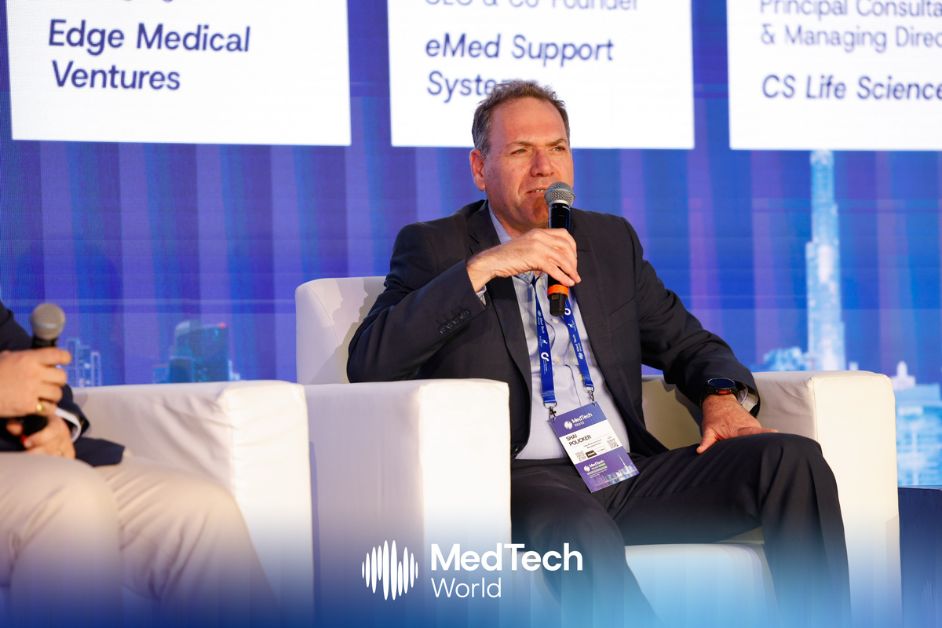
For Shai Policker, the answer begins with unmet need.
Representing Edge Medical Ventures, a venture capital firm investing in clinical-stage companies approaching regulatory clearance and commercialisation, Policker emphasised that founders must think about market access before the product is fully built.
“The market should dictate the product,” he explained. “Regulatory comes second—but if the regulatory barrier is too high, or reimbursement is not viable, the product will never succeed.”
His message to founders was clear:Understand the regulatory and reimbursement pathway early, and align R&D accordingly. Regulation should not be an afterthought—but neither should it drive product design at the expense of real clinical need.
Dr. Amel Havkic, a physician and MedTech advisor, approached the debate from a clinical adoption perspective. “If the question is whether to prioritise regulatory or market validation, the answer is yes—to both,” he noted.
For Havkic, success lies in alignment:
Regulation, he described, is a necessary safeguard that protects patients. However, designing a product purely to satisfy regulatory criteria risks missing practitioner and market needs.
“You should account for regulation,” she said, “but you should not design for regulation.”

Working with over 100 startups to bring products to market, Edwin Lindsay offered a pragmatic perspective from the quality and clinical strategy side.
Too often, he observed, startups become overwhelmed by regulatory complexity before confirming commercial fundamentals.
“The first question I ask founders is not about regulation,” Lindsay said. “It’s: where do you want to sell, and can you actually sell it?”
Market choice determines regulatory pathway, financial planning and clinical trial design. Small startups with limited capital cannot pursue every geography simultaneously. Strategic focus is essential.
He also highlighted a critical shift: while regulatory standards are becoming more harmonised globally, reimbursement systems and market structures remain highly fragmented—particularly in Europe.


Policker reflected on how dramatically the global environment has changed over the past two decades. Historically, Europe was considered the easier entry point for MedTech. Today, the picture is more nuanced: The FDA has become more predictable and structured, with programmes such as Breakthrough Device Designation offering accelerated pathways for qualifying innovations.
The European MDR framework has introduced delays and complexity, particularly around notified bodies and health technology assessment (HTA).
Reimbursement remains a major bottleneck, often more limiting than regulatory clearance itself.
As Policker noted, it does not matter where a company gets stuck—regulatory approval or reimbursement—if progress stalls, funding runs out.
A recurring theme throughout the session was the importance of parallel planning.
Regulatory approval alone does not guarantee commercial success. Someone must pay for the solution.
Early discussions with regulators, thoughtful clinical trial design that can support multiple jurisdictions, and proactive reimbursement strategy can reduce duplication and accelerate market entry.
Planning clinical data collection with cross-border applicability in mind may allow companies to avoid repeating costly trials in different geographies.
When asked what they would do differently, panellists offered tactical advice:
Consider carefully whether a solution qualifies as a regulated medical device or initially fits within a wellness framework—while remaining compliant.
The panel concluded with a unifying insight: products do not go around the world—products go to markets.
Regulation, reimbursement, usability, funding and partnerships must all align around a clear market strategy. There is no universal shortcut. Each geography, technology class and business model requires careful evaluation.
In 2026, successful MedTech commercialisation is no longer about following a predefined path. It is about informed sequencing, early alignment and disciplined focus.
As healthcare systems grow more complex, the companies that will succeed are those that understand not only how to innovate—but how to navigate.

MedTech World heads to Florida from 11 to 13 May 2026, bringing together global MedTech leaders, innovators, investors, and healthcare decision-makers at the Hilton West Palm Beach. Across three focused days, the event will centre on practical discussions, meaningful connections, and perspectives shaping MedTech today. Book your tickets and be part of the conversation in West Palm Beach.