- Summits
- Sponsorship
- Retreats
- Media Opportunities
- News
- About
Bringing a medical technology product to market is rarely a straight path. Between concept and commercial launch lies a series of critical decisions that shape not only regulatory approval but also investor confidence, manufacturing or deployment readiness and long-term commercial success. Founders and product teams must navigate quality systems, clinical evidence, design controls, product claims, regulatory pathways and funding milestones, often while operating with limited resources.
In that environment, choosing a consultancy partner is one of the most important decisions a MedTech company will make. It is not simply about outsourcing regulatory work or producing documentation. The right consultancy helps teams make better decisions, identify risks early and build a product that is ready for scrutiny from regulators, investors and customers alike.
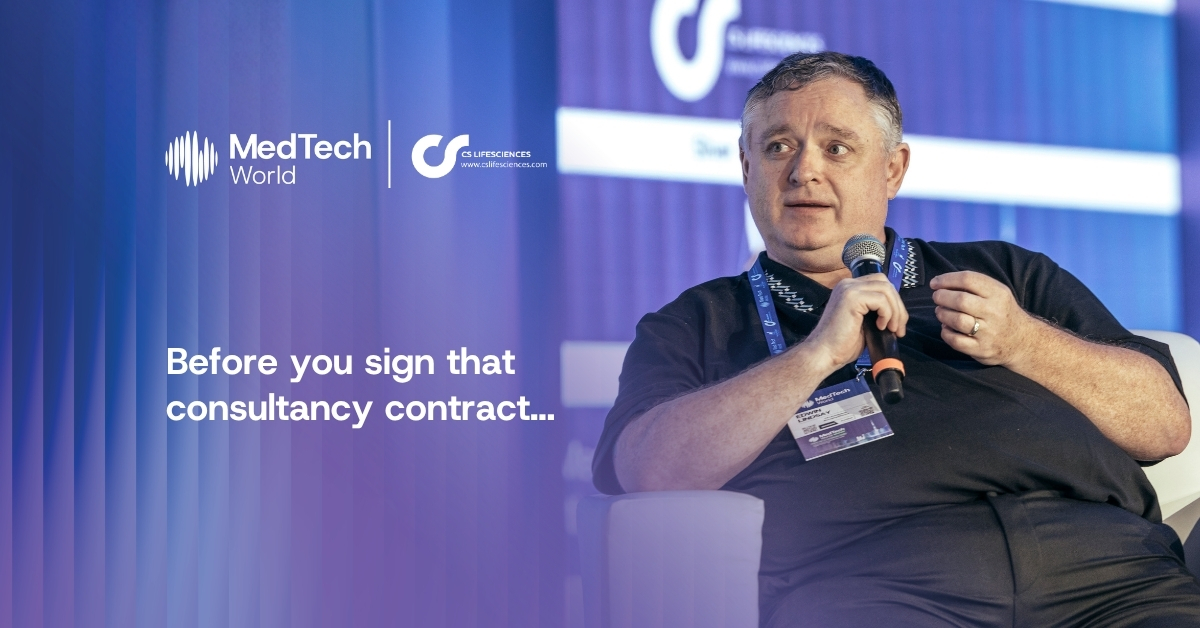
MedTech World explored this topic with Edwin Lindsay, Principal Consultant and Managing Director of CS Lifesciences, an award-winning enterprise regulatory strategy consultancy. His advice is clear: the best consultancy does far more than prepare submissions. It becomes a strategic partner that understands the product, the business and the realities of bringing innovation to market.
No two medical devices follow the same route to market. A connected health platform, AI-powered software, implantable device, diagnostic system or surgical instrument each presents different regulatory expectations, evidence requirements and manufacturing or software deployment challenges.
A consultancy that begins by asking detailed questions about intended use, risk classification, use environment, intended user and clinical evidence is demonstrating the right mindset. One that immediately recommends a standard package without fully understanding the product may be relying on generic processes rather than product-specific expertise.
Founders should ask prospective partners about similar technologies they have supported, the challenges those products faced and how those experiences could apply to their own development process and regulatory market access.
Supporting a startup is very different from advising an established manufacturer.
Early-stage companies are balancing regulatory progress with fundraising, product iteration and limited budgets. They need practical advice that helps them prioritise the work that matters most without creating unnecessary complexity.
Rather than building an oversized quality management system from day one, an experienced consultancy should develop scalable processes that grow alongside the business. Every activity should support the company’s current stage while preparing it for future regulatory and commercial milestones.
One warning sign is a consultancy that proposes an extensive programme before understanding the company’s maturity, funding position or development roadmap.
Good documentation is far more than a collection of templates.
Inspection-ready files should clearly explain what the product does, who it serves, the risks involved, how those risks are controlled and the evidence supporting safety and performance. Every document should be traceable, version-controlled and specific to the product being developed.
Generic documentation often creates problems later during regulatory review, notified body audits, investor due diligence or acquisition discussions because it fails to demonstrate the company’s understanding of its own device.
A capable consultancy develops documentation that supports confident decision-making throughout the product lifecycle rather than simply fulfilling compliance obligations.
One of the most valuable qualities in a consultancy partner is the willingness to challenge assumptions.
Every MedTech programme contains uncertainties. Clinical evidence may be insufficient. Product claims may require stronger validation. Manufacturing plans may introduce supplier risks. AI model performance may not generalize across intended populations. Training datasets may lack diversity, unidentified cybersecurity vulnerabilities may introduce patient risk and Regulatory timelines may be optimistic.
A strong consultancy identifies these issues early and explains their potential impact rather than offering unrealistic reassurance.
Companies should feel comfortable asking prospective partners straightforward questions, including:
If every answer sounds effortless or every approval appears guaranteed, that should prompt further questions.
Change is inevitable during product development.
Requirements evolve. Suppliers change. Software is updated. Materials are substituted. Claims are refined.
Effective change control ensures every modification is assessed for its impact on risk management, testing, regulatory strategy and documentation. Without this discipline, companies can lose traceability and create significant problems during submission or inspection.
However, Edwin Lindsay also highlights another form of change control that startups sometimes overlook: contractual change control.
Some consultancy proposals appear attractively priced because important activities are excluded or only vaguely defined. As the project progresses, additional work is introduced through repeated change requests, increasing both cost and timelines.
Companies should carefully understand exactly what is included, what assumptions underpin the proposal and what circumstances would trigger additional fees. Transparent scope management benefits both parties and reduces the likelihood of unexpected commercial disputes later.
Preparing a regulatory submission is only one part of commercialisation.
Successful market entry also depends on manufacturing transfer, supplier qualification, production controls, labelling, packaging, release processes and post-market planning.
A consultancy focused solely on regulatory documentation may overlook operational issues that become critical once production begins.
The strongest partners understand how design decisions influence manufacturing and how manufacturing readiness ultimately supports regulatory compliance, product quality and commercial success.
The importance of thinking beyond regulatory approval becomes even greater for companies planning international expansion. As medtech businesses prepare to enter new markets, strategic decisions around compliance, manufacturing and commercialisation become increasingly interconnected, an area Edwin Lindsay will also discuss during the panel “Beyond APAC: Building a MedTech Expansion Strategy for Europe and the USA” at MedTech World Asia in Hong Kong, taking place from 26 to 28 August, 2026.
For startups seeking investment or acquisition, due diligence extends well beyond financial performance.
Investors increasingly examine design history files, technical documentation, traceability, intellectual property, supplier management and regulatory strategy.
Weak documentation, unsupported claims or incomplete evidence packages can quickly undermine confidence, even when the underlying technology is promising.
Consultancies with due diligence experience can help companies organise documentation, identify weaknesses and address gaps before external reviewers begin their assessment.
Technical expertise remains essential, but successful consultancy relationships are built on more than regulatory knowledge alone.
The right partner asks difficult questions, explains trade-offs clearly and understands how technical decisions affect commercial outcomes. They recognise that startups operate under financial constraints and help teams sequence activities to maximise both regulatory progress and investor value.
Equally important is their professional network. No consultancy can specialise in every discipline, but experienced partners know when to involve clinical experts, human factors specialists, cybersecurity professionals, manufacturing experts or reimbursement advisers while maintaining overall programme coordination.
Selecting a consultancy partner deserves the same level of scrutiny as selecting a manufacturer, supplier or investor.
Companies should ask for relevant case studies, speak with previous clients, understand who will actually deliver the work and request examples of successful device approvals where the consultancy played a meaningful role. The sales presentation should match the expertise of the team carrying the project forward.
Ultimately, the right consultancy helps build much more than a regulatory file. It helps build stronger evidence, better decisions, greater organisational capability and a more credible business.
As Edwin Lindsay emphasises, success in MedTech is rarely determined by documentation alone. It comes from making informed decisions at every stage of development. Companies that choose a consultancy capable of combining regulatory expertise with commercial understanding give themselves a stronger foundation for moving confidently from idea to market.
As MedTech companies continue to look beyond their home markets, MedTech World Asia 2026 will bring together founders, investors, regulators and industry leaders to discuss the opportunities and challenges of expanding across global healthcare markets. Taking place in Hong Kong from 26–28 August, the event will feature sessions on regulatory strategy, market access, investment, AI, digital health and international growth, offering practical insights for companies looking to scale across APAC, Europe and the United States.
Whether you’re preparing for your first regulatory submission or planning your next international expansion, the conversations at MedTech World Asia are designed to help turn strategy into action. Explore the MedTech World Asia agenda and book your spot now.