- Summits
- Sponsorship
- Retreats
- Media Opportunities
- News
- About
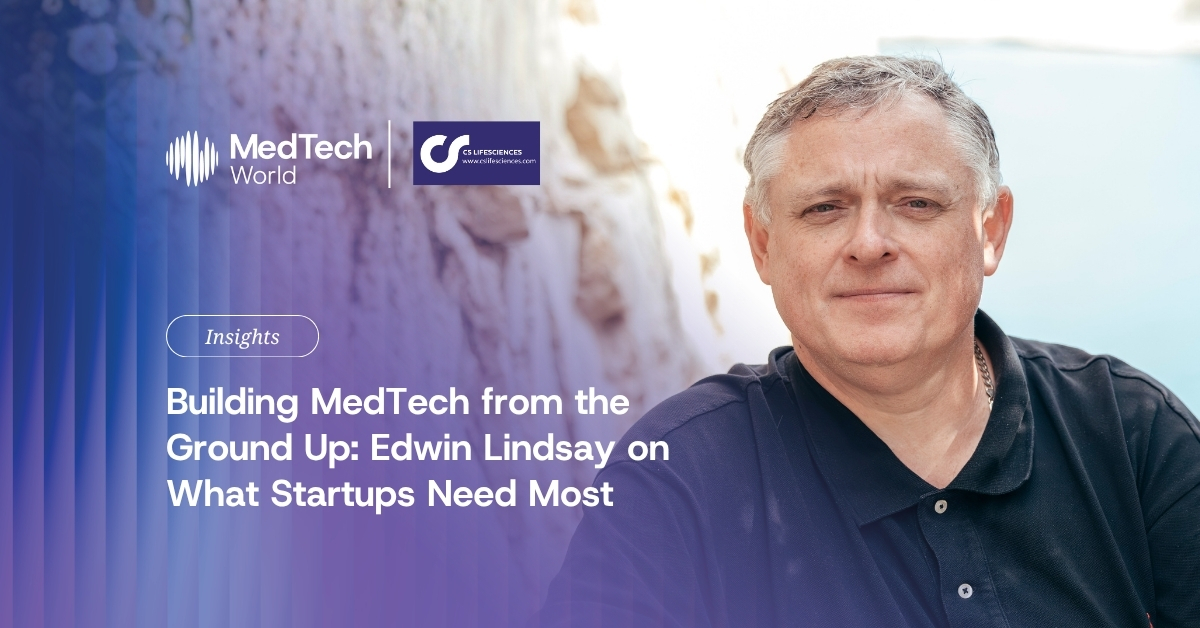
In MedTech, innovation rarely succeeds on product potential alone. The companies that make meaningful progress are often those that build the right foundations early, not only in technology, but across regulatory strategy, quality systems, clinical planning, and commercial readiness.
For Edwin Lindsay, Principal Consultant and Managing Director, CS Lifesciences, supporting startups means becoming a genuine partner in that process.
“At the earliest stages, founders are often navigating multiple critical decisions at once, while moving quickly and working with limited resources,” Lindsay says. “What matters is not simply telling startups what decisions need to be made, but helping them understand the implications, work through the options, and make the right choices for their business.”
This philosophy sits at the heart of CS Lifesciences, where the focus is on practical, hands-on support that helps MedTech companies move from concept to commercialization with greater clarity and confidence.
For Lindsay, partnership goes far beyond a conventional advisory role.
Rather than operating at a distance, his approach is rooted in shared problem-solving, working side by side with founders and leadership teams to help translate strategy into action.
That support may include defining a regulatory pathway, strengthening operational foundations, shaping clinical evidence strategies, or preparing teams for investor and partner scrutiny.
“Early-stage companies need support that is responsive, tailored, and grounded in the realities of growth,” he explains.
“The goal is to build clarity where there is ambiguity, confidence where there is complexity, and structure where there is rapid change.”
This hands-on model is especially important in MedTech, where the stakes are high, and timelines can be compressed.
One of the most common challenges startups face, according to Lindsay, is that they are building their company at the same time as building the systems required to scale it.
Regulatory, quality, and clinical functions often compete with product development for time and attention, yet delaying these foundations can create significant setbacks later.
“A strong product alone is not enough,” he says.
“You need to understand what evidence will be required, what regulatory path makes sense, how the product will be used in practice, and what will ultimately support adoption in the market.”
For many founders, especially first-time innovators, understanding what needs immediate attention versus what can be built in stages is one of the hardest decisions.
Lindsay believes the answer lies in proportionality.
Rather than overwhelming startups with enterprise-level systems too early, he advocates for staged frameworks that grow with the company.
“The balance comes from putting in place what is needed at the right time, rather than building everything at once,” he says. “That allows startups to stay agile while still creating the foundations they will need as they scale.”
A key theme in Lindsay’s approach is that commercialization does not begin after development; it begins during it. He emphasizes the importance of understanding how a product fits into real clinical workflows, patient pathways, and healthcare systems from the outset.
“Founders need to ask early: who is the real user, where does the product sit in the patient journey, and does it fit naturally into existing workflows?” he notes.
These questions, he says, often determine whether an innovation will achieve real-world adoption. By connecting clinical planning, regulatory strategy, quality, reimbursement, and market expectations early, startups are better positioned to avoid costly rework and delays.
As the MedTech landscape evolves, Lindsay expects startup needs to become increasingly interconnected. Investors, providers, and strategic partners are asking tougher questions earlier, not only about innovation, but about clinical relevance, scalability, and market fit.
That is where CS LifeSciences aims to continue adding value.
“We want to be a partner that brings together strategic thinking and practical execution,” Lindsay says. “The startups that will succeed are the ones that can combine innovation with clarity, structure, and real-world applicability.”
For MedTech founders, his advice is clear: start earlier than you think, stay structured, and never lose sight of the end goal: building a product and company that can succeed in the real world.