- Summits
- Sponsorship
- Retreats
- Media Opportunities
- News
- About
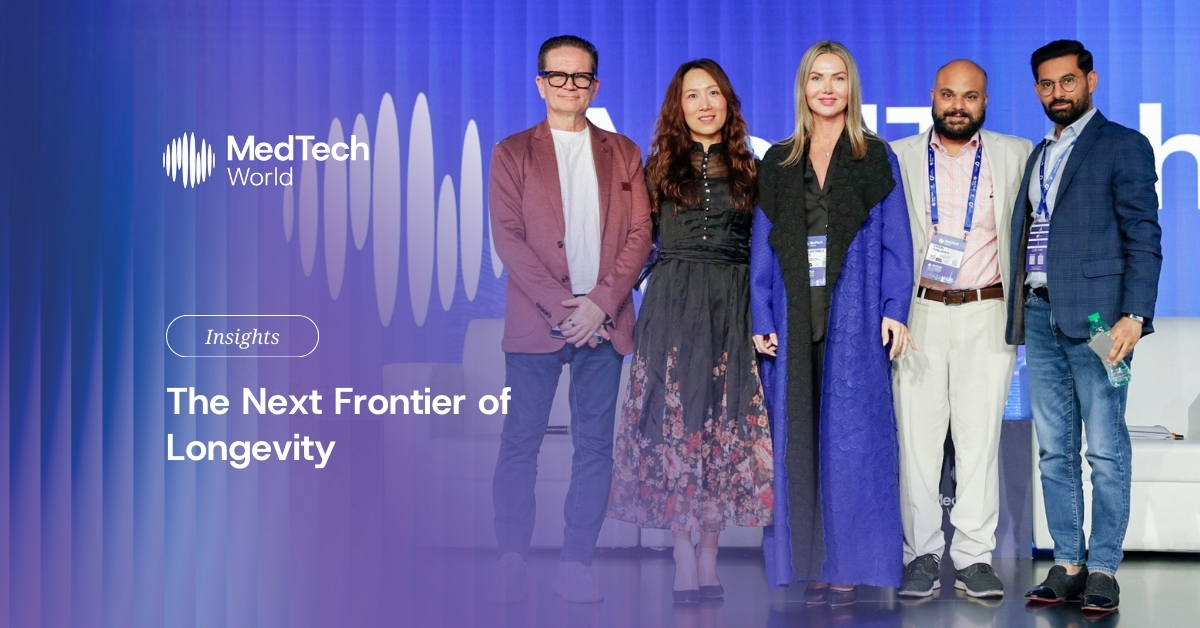
The second day of the MedTech World Middle East conference at Dubai’s InterContinental Festival City focused on the rapidly evolving field of preventative care. A panel titled “The Next Frontier of Longevity” examined how biological enhancement and regenerative medicine are moving from theoretical concepts to practical clinical tools. The session highlighted the shift towards personalised healthcare and the new technologies designed to extend a healthy human lifespan.
The discussion was chaired by Philippe Gerwill, Founder and Managing Director of PGEA Limited and a specialist in healthcare innovation. He was joined by a group of prominent industry figures, including Maria Antonela Axinte, a genetic counsellor and founder of DNA Longevity, and Varun Turlapati, Managing Partner at Chaanakya Capital. The panel also featured investment perspectives from Sahir Ali of Modi Ventures and Soyoung Park of 1004 Venture Partners. Together, they explored the intersection of emerging medical devices and the investment landscape supporting the future of long-term health.
In his opening remarks, Philippe Gerwill emphasised the importance of viewing longevity not as a niche, but as the future of healthcare. “Longevity should be considered the next-generation medicine, accessible to all,” he said. He introduced the panel by discussing the necessity of a ‘longevity GPS’ to help guide innovations in the field. For Philippe, it’s about finding the right direction rather than relying on a crystal ball.
Soyoung Park, General Partner at 1004 Ventures Partners, shared her thoughts on the role of technology in supporting healthy ageing. She highlighted the importance of preventative therapeutics, diagnostics, and next-generation healthcare systems in fostering independent living and caregiving. “In five years, we will see a widespread adoption of technologies aimed at improving quality of life,” she predicted.
Maria Antonela Axinte, Founder of DNA Longevity, underscored the growing importance of genetic counselling. “In the future, longitudinal clinical data will be more widely available, empowering patients with insights that lead to more precise interventions,” she said. Axinte’s work in personalised genomic testing is paving the way for a new era of preventative healthcare.

Varun Turlapati, Managing Partner at Chaanakya Capital, expressed his enthusiasm for the role of neurotechnology in the longevity space. “We are witnessing an explosion of innovation in the field of medical devices, including implants that could revolutionise how we manage chronic conditions,” he noted. He went on to share his excitement about the future of neurotechnology and its potential to improve the quality of life.
Sahir Ali, General Partner at Modi Ventures, elaborated on the investment landscape for longevity technologies. His firm’s focus on the “engineering of life” places them at the intersection of biotech and technology. “Whether it’s stem cells, genomics, or regenerative therapeutics, the key to longevity lies in creating technologies that enhance life at a molecular level,” he stated.
As the discussion moved forward, the panellists explored what the future of longevity might look like. When asked about their predictions for the next five years, the consensus was that longevity technologies will become far more mainstream. “By 2031, the concept of longevity clinics will be part of everyday life, with people accessing personalised services that incorporate genomic data, AI, and biohacking tools,” Varun Turlapati said. He also noted that neurotechnology and other non-invasive treatments would become standard practices, making health management more personalised and predictive.
Maria Antonela Axinte highlighted the role of genetic counselling and AI in making healthcare more individualised. “With AI and genomics converging, we will see a revolution in how we approach preventive care,” she said. Sahir Ali echoed this sentiment, emphasising the need for continued investment in AI-driven solutions that bridge the gap between sensing biology and modulating it for better health outcomes.
The panel concluded by looking toward the future and the role each speaker plays in shaping it. With exciting advancements in AI, medical devices, and biohacking, the longevity sector is poised for rapid growth. The key to success will be ensuring these technologies are accessible to everyone, transforming how we age and live longer, healthier lives.
As the conference wraps up, MedTech World looks forward to its upcoming North American conference, set to take place in Florida, USA, from 11-13 May 2026. Stay tuned as the next frontier of medical innovation continues to unfold.