- Summits
- Sponsorship
- Retreats
- Media Opportunities
- News
- About
The European Commission’s recent Decision (EU) 2025/2371 marks a turning point in the long-awaited rollout of the European Database on Medical Devices. After years of anticipation, four Eudamed modules have now been officially confirmed as fully functional. This announcement brings long-standing discussions into clear focus and signals that mandatory use is no longer an abstract future requirement, but a concrete operational deadline.
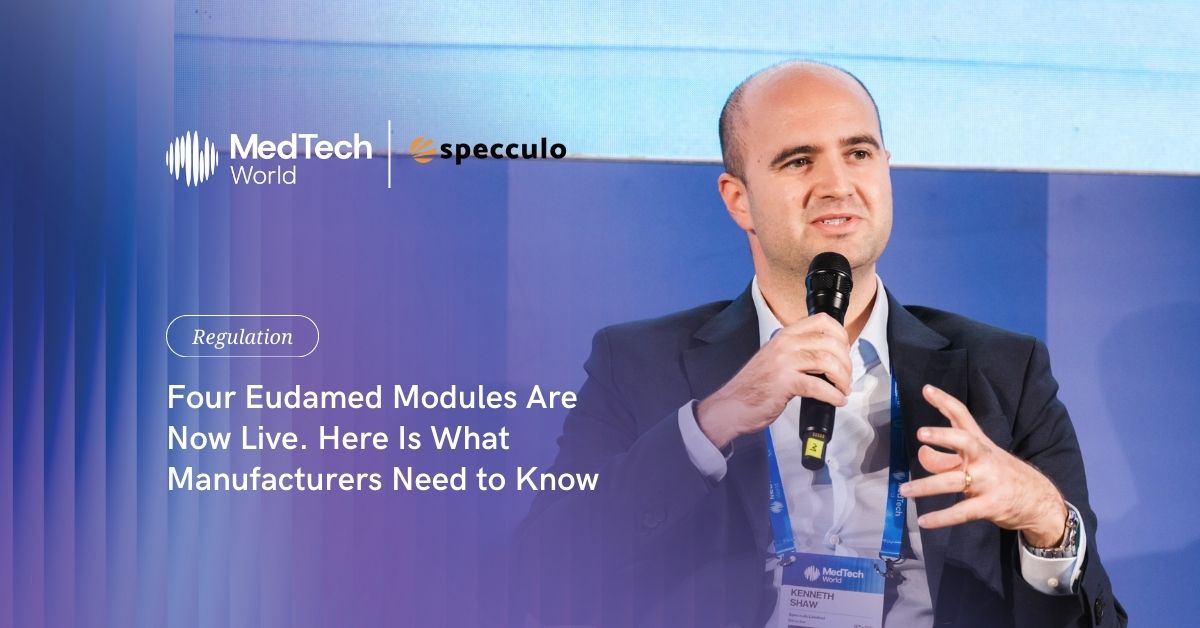
To understand what this means for the industry, MedTech World spoke with Kenneth Shaw, Director at Specculo Ltd, who has been closely involved in supporting manufacturers through Eudamed’s early phases.
The European Commission has now validated four essential modules. These are Actor Registration, UDI-DI and Device Registration, Notified Bodies and Certificates, and Market Surveillance. For Shaw, this confirmation brings both relief and momentum.
“We’ve been waiting for this announcement for years, and although we have already been using some of these modules for some time, we’re pleased to finally see it published in the Official Journal of the EU. It marks a shift towards improved traceability. Both regulators and the general public will benefit from the increased visibility.”

Shaw emphasised that mandatory use begins on 28 May 2026. In his view, waiting is not an option.
“If manufacturers and other economic operators haven’t yet registered their companies on Eudamed, they need to do this soon. These registrations are still being approved by the National Competent Authorities, and timelines vary from country to country. It is advantageous to start early. Once the organisation is registered, the next step is to register medical devices. For manufacturers with large portfolios, planning ahead is crucial.”
Correctly linking devices to their corresponding EU certificates, especially for those requiring Notified Body assessment, is also a key priority.
Among the four validated modules, Shaw expects the Device and UDI Registration module to create the biggest shift.
“The module consists of many fields, and some may be tricky to complete. Even though not all fields are mandatory, leaving them empty without understanding their importance is not ideal. Manufacturers need to understand the requirements and update their internal policies and procedures accordingly. This will be a change from older processes which often only involved internal record updates.”
Smaller manufacturers often have limited regulatory resources, which raises concerns about readiness. Shaw remains reassuring.
“Once you understand the process, registering devices becomes relatively straightforward. There is excellent official guidance, and we have supported many manufacturers either by registering on their behalf or providing training. This is exactly why starting early makes a difference.”
The confirmation of functionality should ease some uncertainty, though it also sets a clear countdown.
“These modules have been live for a few years already. Now the clock starts ticking for mandatory compliance. We have encouraged clients to register early because leaving this activity for the last few weeks is risky. Companies with large device portfolios especially need to plan carefully since registration can take significant time and resources.”
Shaw’s experience with Eudamed gives him confidence in its reliability.
“We’ve been registering devices for at least three years. Apart from scheduled maintenance, the system has been stable. It used to feel more clunky, and the interface could still improve, but it works. What matters now is that manufacturers verify that their registrations remain accurate while their devices are on the market.”

Eudamed’s goal has always been to improve traceability and accountability. Shaw believes the benefits outweigh the administrative lift.
“In terms of traceability, this is a huge improvement. Once mandatory, all stakeholders, including the general public, will be able to confirm that a device has been registered. It also strengthens enforcement. Each country will now be able to verify which devices are being placed on its market. Yes, it adds administrative pressure, but that is also the case in other jurisdictions.”
Common errors mostly come from misunderstanding fields or failing to plan ahead.
“Many companies complete some fields incorrectly. We recommend first understanding which fields apply, then preparing a document listing all UDI-DIs alongside the required fields. This helps ensure accurate and efficient registration.”
Shaw expects some strain on Notified Bodies, but not a breakdown.
“They are inundated. We are confident that most will keep up with certificate registration and verification, but there may be delays in some cases. Manufacturers may feel some frustration, although strong internal processes and adequate training should help Notified Bodies handle the increased load.”
Shaw emphasised that early action is the strongest advantage manufacturers can give themselves. He noted that “start as soon as possible and seek out available guidance or professional assistance to ensure your strategy makes sense”, adding that proactive planning will reduce stress, minimise errors, and give organisations enough time to adapt their internal procedures without pressure.
The Commission’s confirmation does more than validate system functionality. It signals that regulatory expectations are tightening, traceability is becoming more central, and companies that delay will face unnecessary pressure. Early action, internal alignment, and a structured registration strategy will determine whether organisations transition smoothly or struggle as the deadline approaches.
If you would like support navigating similar regulatory updates and insights from leaders across MedTech, join us at MedTech World Dubai 2026, taking place from 11 to 13 February 2026. Explore opportunities to speak, sponsor, pitch, or exhibit, connect with global innovators, and stay ahead of upcoming regulatory shifts.