- Summits
- Sponsorship
- Retreats
- Media Opportunities
- News
- About
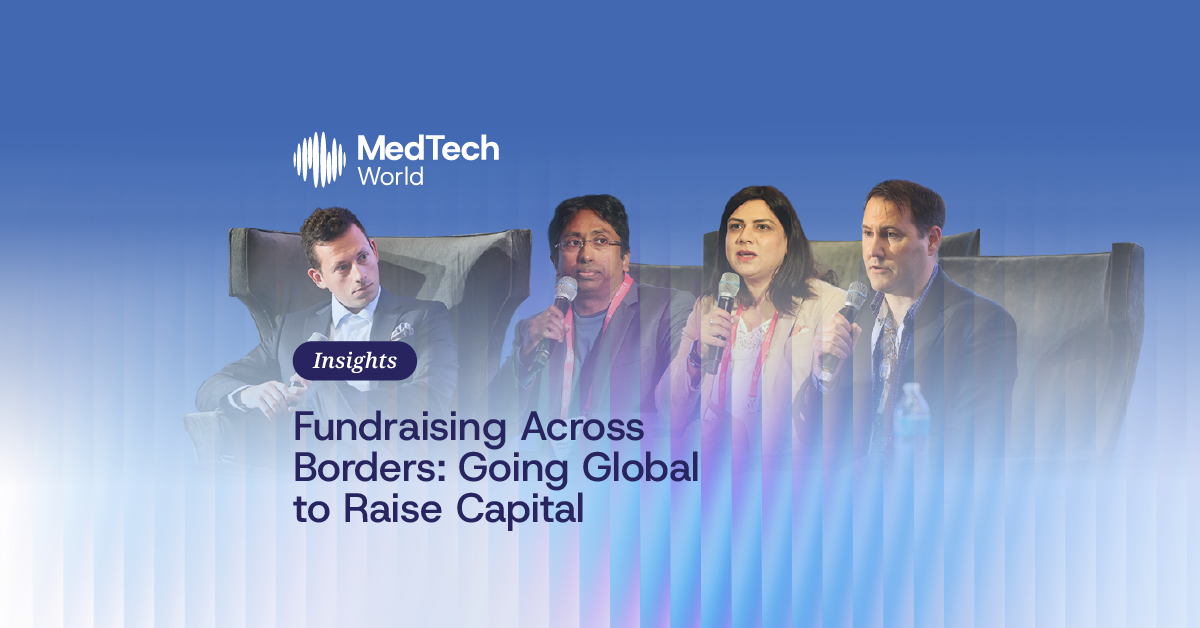
Expanding beyond one’s home market to seek funding is no longer optional for many MedTech startups—it’s a necessity. With investors adopting different risk appetites, healthcare needs spreading across regions, and capital pools shifting, founders are increasingly exploring opportunities far from their own backyards. But raising funds across borders comes with unique challenges: cultural nuances, investor expectations, regulatory considerations, and the art of storytelling across diverse audiences.
This was the focus of the panel “Fundraising Across Borders: Going Global to Raise Capital,” moderated by Dr. Dylan Attard, CEO, MedTech World, and featuring David N. Constantine, Co-Founder & CEO of Juniper Biomedical; Ruchi Dana, Partner at MFV Partners; and Prakash Thakur, Head of Healthcare & Life Sciences, UK Department for Business & Trade.
Opening the discussion, Dr. Dylan Attard explained why the topic resonates so deeply with MedTech World:
“This panel is very close to MedTech World’s heart. Since our inception, our focus has been on going global—exploring different ecosystems across continents, wherever MedTech and healthcare innovation is happening. We’ve worked to leverage those connections and bring people together, whether across the Atlantic, the Pacific, or beyond.”

He underlined that the panel was designed to give practical advice to startups seeking international capital, drawing from the experiences of founders, investors, and policy leaders.
As someone actively raising capital, David Constantine shared his personal approach:
“This wasn’t my first time pursuing global investment, nor was it the first time we closed global investment. … the number one thing that we took away from taking on a component of our fundraising strategy to include global investment was simply just gaining comfort, foundational comfort that your investors do not need to come from your backyard. … the key is talk to a lot of people that could offer their perspective and their experience of what worked well for them and what didn’t work.”
For Constantine, the process was about broadening opportunities and being prepared to adapt to nuanced investor expectations across regions.
From the investor’s side, Ruchi Dana emphasized that startups often underestimate the importance of cultural context:
“One very very important thing when startups come to countries like the Middle East is to understand the cultural barriers there… if you don’t use the local language you can’t really model yourself in such countries because cultural barrier is a huge barrier. … It’s not just a copycat model that will work in the Middle East. You need to understand how those countries function, how to build relationship with not just the investors but then all the stakeholders, the hospitals, the insurance companies, how does reimbursement work there.”

She added that investors from the Middle East are increasingly proactive in scouting opportunities worldwide:
“It’s not just technologies who want to have a presence in the Middle East. It’s also like just US-based startups. … If you’re in the medtech or the healthcare industry, it evolves so fast. If you just wait for startups to come to the Middle East, you’ll end up investing in the leftover deals that nobody really wants.”
Her advice for founders: build trust, follow up consistently, and come prepared with strong data rooms and cultural awareness.
Representing policy and trade, Prakash Thakur spoke about the opportunities between the UK and US, highlighting three critical factors:
“Number one is there a appetite for adoption of my technology there. Number two, is there good enough investment pool that I can syndicate my investment … and thirdly beyond the adoption what is also needed is the talent pool because you want to have some operational presence in that country.”
Thakur also reminded founders that MedTech, unlike other tech sectors, demands deep expertise, regulatory compliance, and long-term validation:
“MedTech is a sector where you rarely see somebody with a college dropout can go and build a successful company unlike gaming or mobile apps. Most founders tend to be PhD or MD holders because it is very specialized.”
Addressing whether non-US investors are now seen as equally credible, Constantine reflected:
“I would say so absolutely but I think it’s not new. … as we see more and more good successful exits from companies that have raised foreign capital, it just makes some of us in the earlier phase very comfortable approaching those funds and recognizing that they’re credible in many respects.”
Still, he warned that founders must be prepared for cultural and regulatory nuances when approaching international investors.
Dana highlighted a recurring mistake she sees in startups seeking global capital:
“If you think you’ll just come there for one conference and go back and maybe not even follow up much and the capital will just come to you—that’s not how things work. You need to follow up a lot… It’s a lot about the relationships that you build over time and how culturally sensitive you are to those regions.”
She also pointed to the importance of timely due diligence and preparation of investor materials.
As the session drew to a close, the panelists each shared a core lesson for founders:
The panel reached a clear consensus: raising capital across borders is very much achievable, but it requires more than just a great product. Founders must embrace cultural awareness, sharpen their storytelling, build long-term relationships, and prepare meticulously for investor expectations in each region.
For conversations like this and many more, MedTech Malta 2025 will bring together global leaders, innovators, and investors from 12 to 14 November in Valletta. The gathering offers opportunities not only to engage in thought-provoking discussions but also to showcase expertise, forge collaborations, and highlight groundbreaking solutions on an international stage.
Sponsorship, speaking, and presenting opportunities are now open. For more details, contact [email protected].