- Summits
- Sponsorship
- Retreats
- Media Opportunities
- News
- About
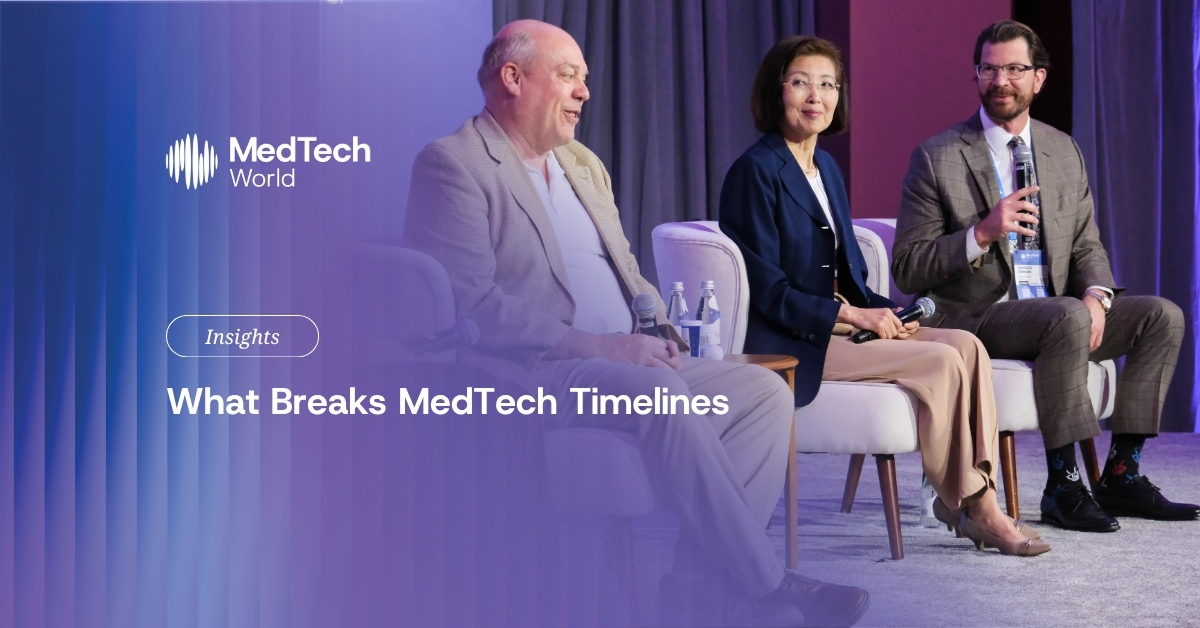
The “What Breaks MedTech Timelines” panel was held at the Hilton West Palm Beach on May 13, 2026, as part of the MedTech World North America Summit in West Palm Beach, Florida, and featured representatives from across the MedTech Industry’s value chain. The panel explored operational and organisational issues that inhibit product commercialisation and moved beyond the technology discussion to examine what is going wrong in getting new products to market, to develop solutions to overcome obstacles to commercialisation.
The panel included Joseph Panetta, Chief Marketing Officer, Ascend CRO; Lynn Carney, Director, Agency and Alliances, Medmarc; Lian Cunningham, VP Clinical Affairs, Endogenex; Mark Swanson, Partner, QRx Partners; and Charles Dunham, Shareholder, Greenberg Traurig, LLP who examined why MedTech innovations stall before reaching market.

Many delays stem from insufficient regulatory and reimbursement planning. This is often seen when manufacturers do not have the necessary reimbursement structure in place when they begin their product, or do not have a strategic plan for how they will operate together to accomplish their goals.
Start-up companies are still creating regulatory strategies late in their development cycle. Companies may have significant parts of their product made. This causes redesigns, additional studies and integration delays, which can add months or even years to the timeline.
Moreover, another major obstacle to growth is the legal framework. As part of due diligence, there may be issues with equity arrangements, including a lack of formalised market-entry agreements or clarity on how risk will be shared. All these issues typically arise in the context of successful fundraising, but, given their presence, they should ideally be addressed earlier in the lifecycle.

Delays in clinical trials are generally caused by miscalculating the difficulty of scaling studies after a pilot phase. Factors that typically lead to bottlenecks include recruitment timeframes, protocol changes, multi-site coordination, and data inconsistencies arising from poorly designed data collection processes.
Cunningham stated that trial objectives must be compatible from the start for both clinical and commercial purposes. A device may be shown to have technical performance. Still, if the clinical evidence is insufficient, it could mean the company needs to complete subsequent trials, which can increase costs and the time required to bring the device to market. Stakeholders such as regulators, clinicians, investors, and research teams tend to operate on separate frameworks and will therefore often have differing expectations of a device, leading to fragmented decision-making. If development pathways are not centrally coordinated, they may drift, leading to inefficiencies throughout a device’s life cycle.
To address this, speakers pointed to the growing adoption of cross-functional governance structures. These structures improve accountability across product, clinical and commercial functions.
Reimbursement is still too often treated as a downstream concern rather than a strategic input in early development.
Even strong technologies can struggle without clear, evidence-based reimbursement pathways. Consequently, investors are now assessing the reimbursement readiness of their investment candidates at much earlier stages of the funding process than has historically been the case.
This change in investor thinking reflects broader shifts in capital markets and investor expectations, as companies clearly need to demonstrate their understanding of payer systems, coding paths, and the financial impact of their technology before investors commit. Companies relying solely on technical innovation to attract sustained support are finding that it is no longer enough.
The need for stronger health-economic evidence is also increasing across healthcare systems. Providers and hospitals are placing greater emphasis on measurable outcomes, including cost reduction, improved operational efficiency and enhanced patient quality of life. Without this evidence base, even highly innovative solutions can struggle to gain traction in procurement and adoption processes.
Despite the challenges discussed, the session remained firmly focused on solutions. A consistent message was that many delays are avoidable through stronger collaboration, earlier planning, and more realistic expectations about development complexity.
Specialist partnerships were identified as a key enabler of efficiency. Experienced advisors, contract research organisations and legal and reimbursement experts can help identify risks early, before they escalate into structural delays. The panel encouraged a more integrated approach to decision-making, reducing siloed working practices that often slow progress.
Insurance and risk management were also highlighted as increasingly important considerations as MedTech companies navigate more complex clinical and commercial environments. As the sector evolves, organisations must balance operational uncertainty with investor confidence and regulatory compliance.
Ultimately, the panel reinforced a clear industry shift. Innovation alone is no longer enough to guarantee success. Commercialisation depends on disciplined execution, early regulatory foresight and the ability to align clinical, financial and operational strategies from the earliest stages of development.
Attention is already turning toward the next edition of MedTech World North America 2027, with pre-registrations now open for the event taking place from May 5–7, 2027. Alongside discussions on investment, innovation, and commercialization, the 2027 edition will also introduce dedicated startup tracks designed to further support early-stage companies navigating growth, partnerships, and market entry within the global MedTech ecosystem.