- Summits
- Sponsorship
- Retreats
- Media Opportunities
- News
- About
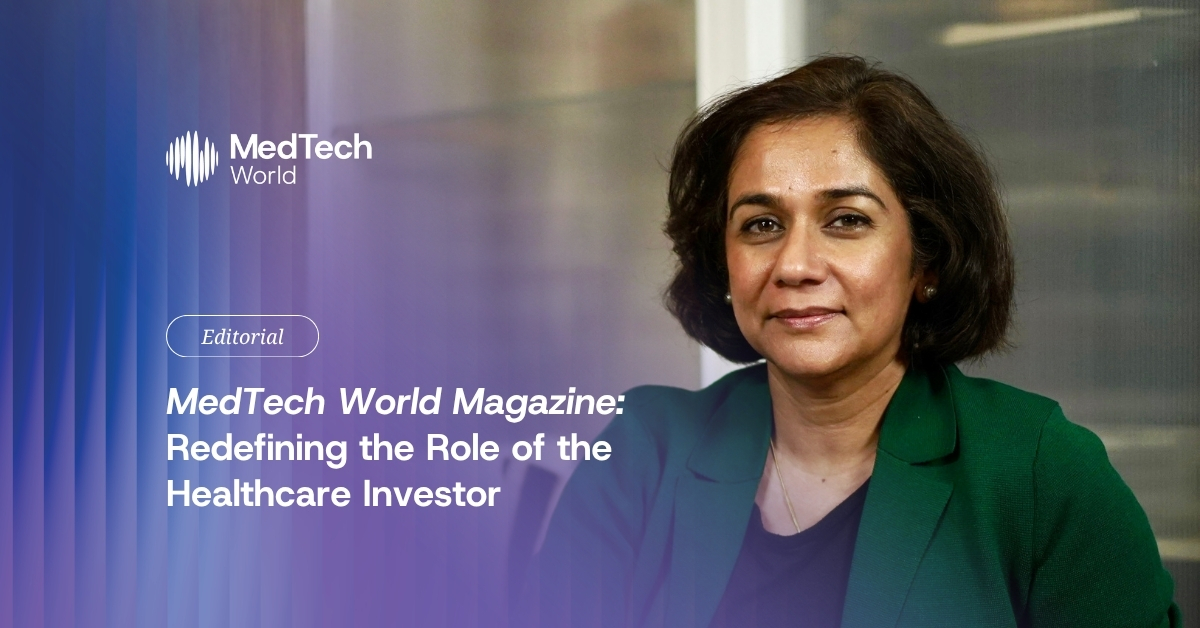
In healthcare and MedTech, capital is necessary – but rarely sufficient. Building technologies that genuinely improve human health requires more than funding rounds and financial projections. It demands patience, technical understanding, and most importantly a willingness to stay close to the realities of medicine long after the check is written. This belief sits at the core of how Rachna Dayal, Founder and Managing Partner at Sugati Ventures, approaches investing.
With an engineering background and professional experience spanning three continents, Dayal brings a perspective that is both global and deeply technical. Today, she focuses on medical devices and AI-enabled platforms. Not because healthcare is fashionable, but because it is one of the few sectors where impact is unquestionable: “There was no doubt in my mind that healthcare was one of these areas where I would not question impact: every medical device, pharma drug or AI platform that I work with either saves lives or makes people healthier and happier. That is where I draw my inspiration from”, she says.
Dayal’s global experience strongly shapes how she evaluates innovation. Opportunity size, in healthcare, cannot be confined to a single geography. Diseases do not respect borders, and neither should solutions. “If a medical device or platform cannot create impact globally, it becomes a limited vision,” she explains. At the same time, global thinking is not about assuming uniformity: “True innovation comes from diverse perspectives. How we lead our lives, how we deal with situations, our culture, our climate, it all shapes our perspective and thinking process.” True scale requires understanding both similarities and differences, a balance she sees many companies underestimate.
Technical depth is also fundamental in healthcare investing. Being able to quickly evaluate the strengths and weaknesses of machines, software, and AI architectures allows her to go beyond surface-level narratives.
What most clearly differentiates Dayal, however, is her view of what it means to be an investor in healthcare. “I believe a VC’s job begins with writing the check and not ends with it,” she says. In MedTech and HealthTech, startups face a uniquely complex set of hurdles: regulatory approval, human safety, clinical trials, usability, clinician adoption, reimbursement, and payer alignment – often all at once. Capital alone does not solve these problems.
As a hands-on investor, Dayal is offering operational guidance, strategic input, and access to a global network of clinicians, partners, and co-investors. This advisory role reflects a broader shift she believes is necessary in regulated sectors. Investors must continue learning, stay close to evolving technologies, and recognize the limits of their own expertise. No one can master every dimension of healthcare, which is why Dayal relies on a collective model, drawing on expert advisors who bring complementary skills to the table.
Of course, nowadays many healthcare investors are focused on AI. But Dayal is wary of hype. She avoids startups that are little more than “wrappers” around foundational models, or those unable to work with unstructured data, which is a critical limitation in a field where clinical notes, images, voice data, and fragmented records are the norm. If a system cannot handle that complexity, she questions whether it can truly function in healthcare at all.
More fundamentally, Dayal believes AI should not be treated as a standalone feature. Instead, she envisions it as an operating system embedded across healthcare environments. Hospitals, she notes, are already overwhelmed by disconnected point solutions that do not communicate with one another. What they need are integrated AI systems working quietly in the background, processing data, automating tasks, supporting reimbursement workflows, and optimizing clinician scheduling – all without adding friction or compromising safety.
This philosophy is reflected in the projects Dayal feels most connected to within her portfolio. One is Neurava, a company addressing the challenge of sudden death in epilepsy. By combining medical devices with AI, the team monitors seizure-induced cardiorespiratory collapse and alerts caregivers and clinicians in real time.
Another is Perceive Now, a company developing an agentic AI operating system designed to function across messy, incomplete, and unstructured data environments. Built with multiple layers of validation and enterprise-grade AI swarms, the platform aims to deliver explainable, audit-ready decisions by default – a critical requirement in healthcare and other regulated industries.
Behind these roles, however, there is also a deeply personal dimension. This past year marked the loss of Dayal’s father, an experience that shaped her reflections on purpose and legacy. He instilled in her a sense of confidence and freedom, encouraging her to think globally and pursue unconventional paths. In an industry often reduced to capital flows and technology stacks, this is a reminder for everyone of us that behind every ambition and achievement, there is a human story.
And this is what we can learn from Dayal’s story and approach to healthcare: healthcare innovation is ultimately built by people, for people. And the role of the investor, when done well, is not to stand apart from that reality – but to engage with it from start to end, and even beyond.
Get featured in MedTech World Magazine, a curated publication for senior decision-makers across the global MedTech ecosystem. Distributed at MedTech World’s flagship events, each edition extends on-stage conversations into practical industry insight.
Read this edition, or apply to be featured.
Following the success of its Middle East flagship event, MedTech World is now heading to Florida for MedTech World North America, taking place in West Palm Beach from May 11 to 13, 2026.
If you are looking to be part of this milestone flagship event, you can engage in ways that align with your goals: