- Summits
- Sponsorship
- Retreats
- Media Opportunities
- News
- About
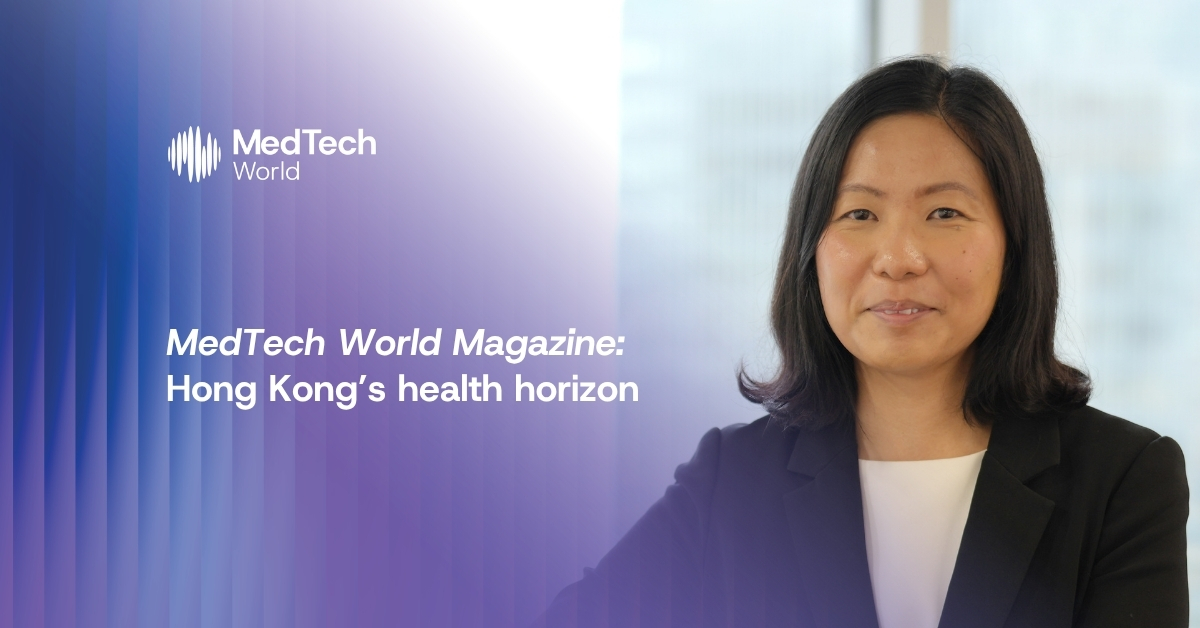
Hong Kong is on a mission. Once known primarily as a financial powerhouse, the city is now positioning itself as a leading hub for medical technology and life sciences. At the center of this push is OASES, set up to help global innovators thrive in Hong Kong’s growing ecosystem.
Naomi Day sat down with Dr. Maggie Lo, Chief Manager of Life and Health Technology at OASES, to discuss why Hong Kong is a prime destination for MedTech companies looking to expand across the region.
For companies looking to expand into Asia, geography and connectivity matter. Hong Kong sits at the heart of the region, offering unparalleled access. “If you were to choose one place in Asia-Pacific to set up, Hong Kong is it,” says Dr. Lo. “We’re just four hours from the major Asian markets and five hours from half the world’s population. On top of that, we’re part of the Greater Bay Area, which gives access to a population of 86 million.”
Location is only part of the story. Hong Kong also offers an international business environment. As Dr. Lo notes, “It’s an incredibly easy place to set up, English and Chinese are spoken, we operate under common law and our tax regime is one of the most straightforward in the world.”
Hong Kong is home to five universities in the world’s top 100 and two medical schools ranked in the global top 30. Dr Lo. points to multiple cases of world renowned clinical researchers. One standout example is Professor Dennis Lo, whose pioneering blood test technology for Down syndrome detection has become standard practice worldwide.
“These are the kinds of innovators companies can collaborate with. We have a steady pipeline of R&D talent graduating every year. With our Science and Technology Park now home to over 300 biotech firms, those graduates are staying in Hong Kong instead of moving abroad,” Dr Lo explains.
Hong Kong’s dual-track healthcare model, combining public and private systems, has produced the longest life expectancy in the world. “Our clinicians are willing to try new things, even first-in-human trials. Global companies trust our doctors and that’s critical when you’re investing billions to bring a drug to market.” The city’s efficiency is also a draw. Roche, for instance, recently obtained full approvals for a clinical trial in just two months, compared with the typical six to nine months elsewhere.
Hong Kong’s 30 years of digitised medical records covering 11.5 million patients also provide a powerful dataset. Dr. Lo highlights how GSK is using this data to track the broader health impact of its shingles vaccine, exploring potential links to reduced dementia and heart disease risk.
Policy reforms are reshaping Hong Kong’s regulatory landscape. In 2023, the city announced the creation of the Centre for Medical Products Regulation (CMPR), its equivalent of the FDA. “We’ve moved from requiring approvals in two overseas jurisdictions before entry to now offering primary reviews here in Hong Kong. Under our new one-plus-one system, 14 innovative drugs have already been approved in less than a year.”
Cost is another differentiator. Registering a new drug in Hong Kong costs just US$150, while medical device registration is currently free. Once approved locally, products can enter the Greater Bay Area’s Green Channel. “It means companies can start small here, prove credibility and then scale across the region.”
Hong Kong offers rich funding options for MedTech. Since 2018, the Hong Kong Stock Exchange’s Chapter 18A listing regime has enabled pre-revenue biotech companies to raise US$15.6 billion.
But IPOs are only part of the picture. “We’re seeing more venture capital and private equity with a biotech focus, multinational funds partnering with universities, and even 3,000 family offices establishing in Hong Kong. The government is also a patient investor, with over HK$26 billion invested in innovation and technology since 2015.”
Hong Kong’s ambitions are bold. The government has devoted one-third of its land in the Northern Metropolis to innovation and technology, including a new cross-border technology park in Shenzhen.
“This is just the beginning,” Dr. Lo affirms. “We welcome companies in advanced treatments like cancer therapies, gene and cell therapy, and rare diseases. Hong Kong offers a gentle, familiar way in for overseas firms, but once you’re here, the opportunities to scale are enormous.”
With the groundwork laid and opportunities opening up, Dr. Lo points to Hong Kong’s exciting next chapter: “There’s no turning back. The foundations are in place, and now it’s about bringing the right partners here to build the future of MedTech together.”
Get featured in MedTech World Magazine, a curated publication for senior decision-makers across the global MedTech ecosystem. Distributed at MedTech World’s flagship events, each edition extends on-stage conversations into practical industry insight.
Read this edition, or apply to be featured.
The conversation continues at MedTech World Asia 2026, taking place in Hong Kong from 26–28 August 2026. Join healthcare leaders, investors, startups, clinicians, and decision-makers from across the global MedTech ecosystem for three days of discussions, networking, and opportunities across the industry.