- Summits
- Sponsorship
- Retreats
- Media Opportunities
- News
- About
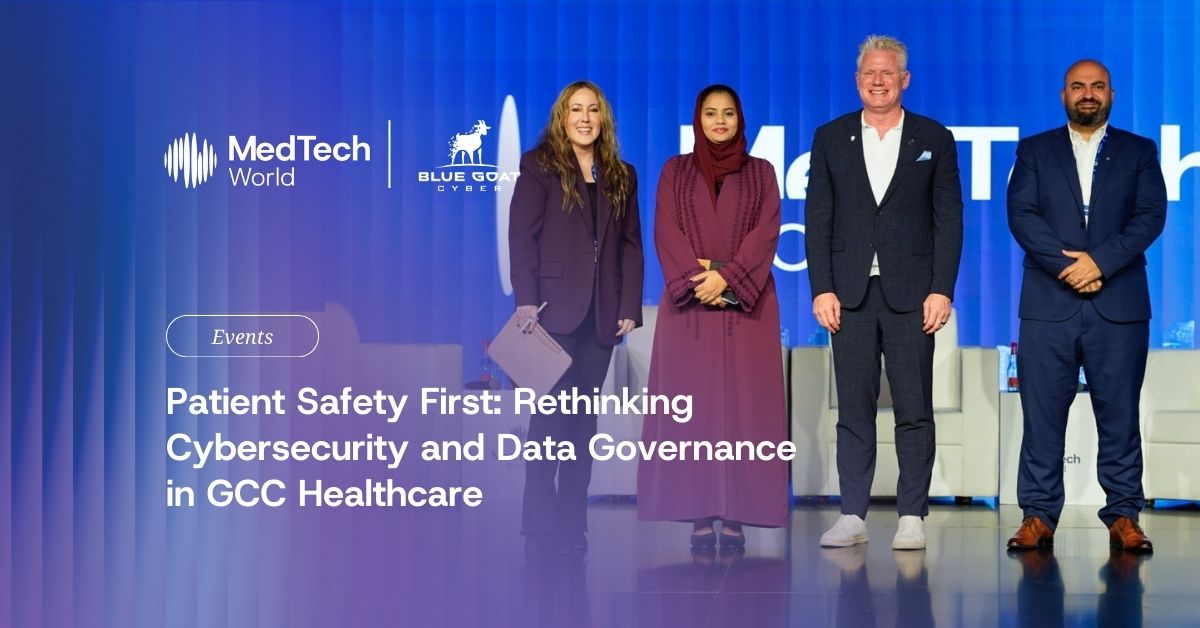
At MedTech World Middle East | Dubai 2026, the panel “The Trust Layer: Data Governance & Patient Safety for Scalable HealthTech in the GCC” brought together regional and global leaders to examine a question that sits behind every AI deployment, connected device, and digital health platform: can innovation scale without compromising patient safety?
Moderated by Rachel McArthur, Chief Editorial Director, Healthcare at Digital Ink Media, the discussion featured:
Together, they explored how governance, cybersecurity, and operational accountability determine whether healthtech in the GCC accelerates responsibly or stalls under risk.
Innovation Is Moving Fast. Governance Must Keep Up.
Rachel McArthur opened the session by framing the regional reality. Digital health adoption across the GCC is accelerating, from AI-assisted diagnostics to virtual care platforms and connected devices. But behind the headlines, the real conversations are about risk.
Risk to:
And as McArthur noted, MENA is not one-size-fits-all. Regulatory maturity, infrastructure, and digital readiness vary widely. The GCC, in particular, is scaling quickly and often centrally, which means both opportunity and exposure expand at speed.

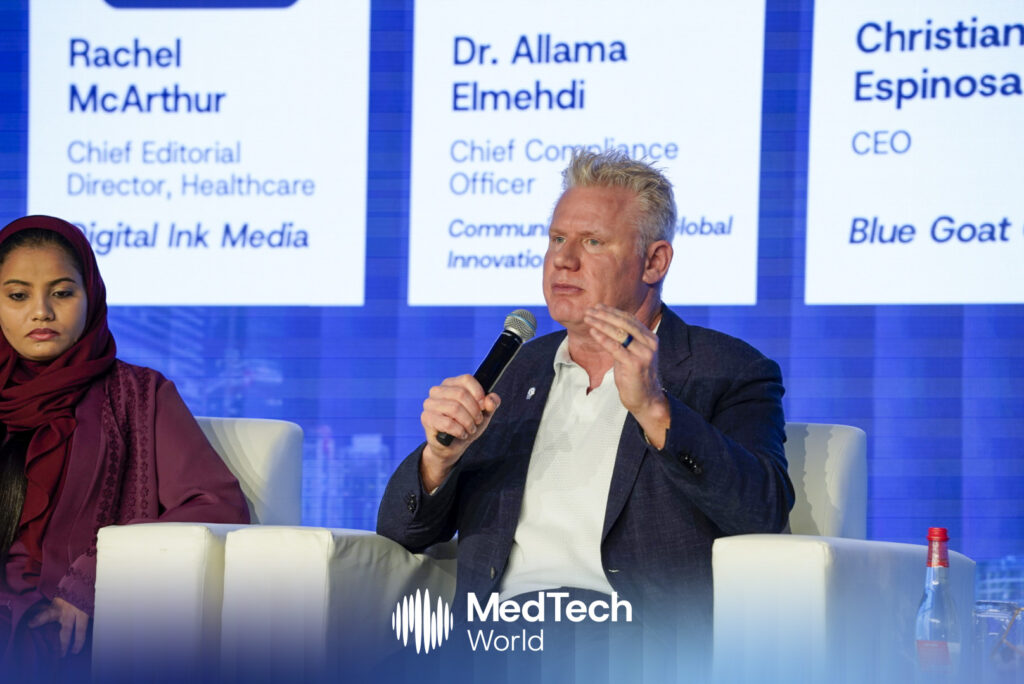
From a global perspective, Christian Espinosa challenged one of the most common misconceptions in MedTech: that cybersecurity is primarily about protecting patient data.
“It’s not just about data protection,” he emphasised. “It’s about patient safety and clinical continuity.”
If a device is compromised, the issue is not only a privacy breach; it may directly affect clinical outcomes. A vulnerability in a connected device could interrupt workflows, lead to misdiagnosis, or cause harm. In that context, cybersecurity becomes a patient safety issue.
Espinosa also highlighted a common misunderstanding among MedTech innovators: regulatory approval is not the finish line; it’s the starting line.
Beyond regulatory clearance, companies must pass what he described as the “deployment gate.” Hospitals require evidence:
In a region like the GCC, where solutions can scale quickly across multiple facilities, these questions become critical.
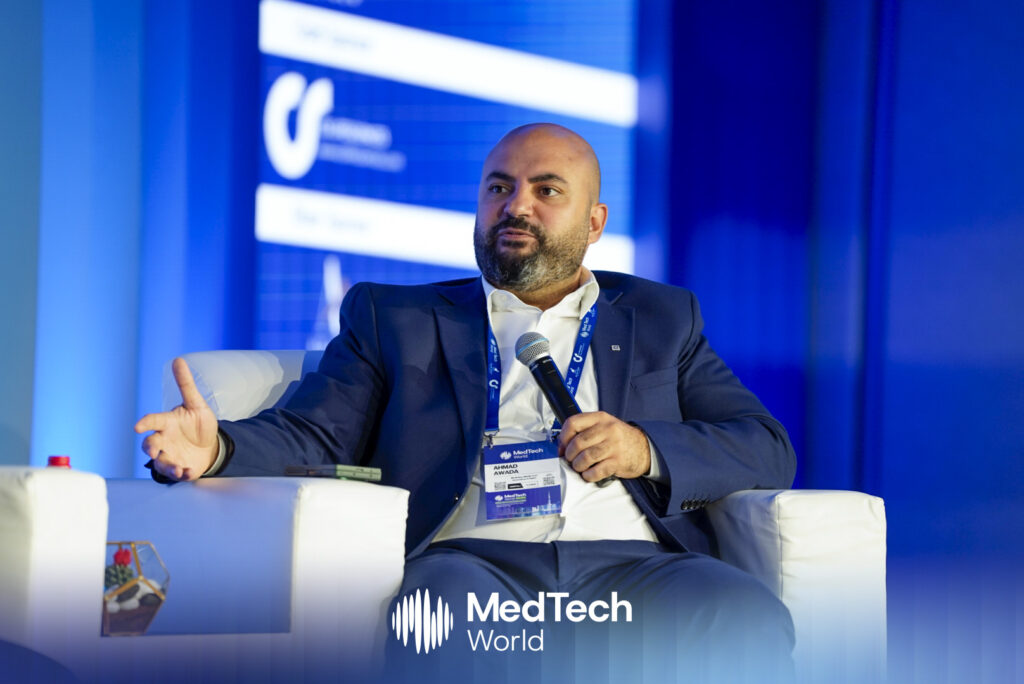
From the provider side, Ahmad Awada offered a practical lens on what “scale” actually looks like within a regional healthcare system.
For Mediclinic Middle East, scale is not a pilot or proof of concept. It means full implementation across hospitals and clinics, with safe migration of data, validation of patient relationships, and strict oversight of consent and access controls.
He acknowledged that while innovation is necessary, healthcare systems cannot afford shortcuts. Encryption, vulnerability assessments, and local data compliance are not optional. Yet at the same time, governance must be applied pragmatically.
“If we follow every requirement by the book without flexibility,” he noted, “we risk blocking innovation.”
That balance, protecting patients while enabling innovation, is where governance must evolve from bureaucracy into an enabler.
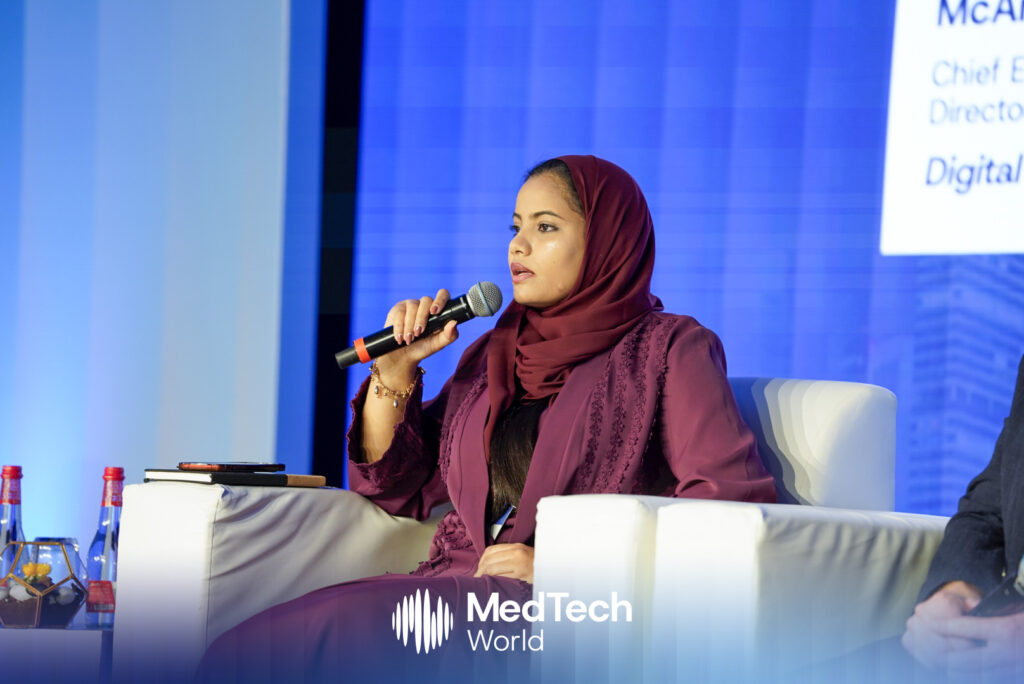
Dr. Allama Elmehdi brought the discussion to fundamentals: nothing is negotiable in healthcare.
For her, trust begins with:
As GCC systems digitise rapidly, the gap between innovation speed and compliance maturity becomes more visible. Bridging that gap requires clarity on ownership, who owns the data, who controls it, and where it resides.
Beyond technical safeguards, she stressed that governance must be embedded culturally. Every healthcare worker, not just compliance officers or data protection leads, carries responsibility.
“Even in a data-driven system, it is still driven by people.”
Without ethical mindset and shared accountability, no technical control can fully protect a health system.
As AI tools increasingly augment clinical decisions, the panel addressed a key question: when something goes wrong, who is accountable?
Awada was clear: AI remains assistive. The clinician remains the final decision-maker. Technology may augment knowledge, but responsibility ultimately rests with the human using it.
Espinosa added that accountability must be clearly delineated across manufacturers, hospitals, and regulators. Shared responsibility models fail when communication lines are vague or untested.
Incident response plans must not only exist — they must be practiced. At scale, assumptions are costly.
In closing, Awada reflected on the UAE’s regulatory landscape, noting its increasingly progressive approach. Regulators are raising standards while remaining open to dialogue, a two-way engagement that supports both protection and innovation.
Espinosa echoed a broader global shift: cybersecurity in healthcare is finally moving from afterthought to forethought. Mandates and regulatory frameworks are pushing manufacturers to design security in from the start, improving patient safety in the long term.
The session underscored that governance is not a compliance checklist. It is strategic infrastructure.
In the GCC, where healthcare digitalisation is advancing rapidly, scalable healthtech depends on:
Innovation may drive momentum, but trust determines longevity.
As health systems across the GCC continue to adopt AI, connected devices, and data-driven models, the real differentiator will not be speed alone. It will be the ability to scale responsibly, with patient safety at the centre.
Missed the session or want to revisit the discussion in full?
Watch everything that’s happening throughout the day at MedTech World Middle East | Dubai 2026 on our official YouTube channel here.
Looking ahead, the conversation continues at MedTech World North America, taking place in Florida, USA, from 11 to 13 May 2026. Join global leaders, innovators, investors and healthcare decision-makers as we examine what’s next for scalable, responsible health technology.
Secure your place and be part of the next chapter.