- Summits
- Sponsorship
- Retreats
- Media Opportunities
- News
- About
As early-stage MedTech companies move from concept to commercialisation, regulatory strategy and quality management decisions are becoming increasingly important from the very beginning. Investors are placing greater emphasis on regulatory clarity, while founders are expected to balance speed, compliance, scalability, and operational execution at the same time.
QRx Partners works with MedTech startups navigating these challenges, supporting companies across medical devices, pharmaceuticals, biologics, and in vitro diagnostics. The firm focuses on helping startups establish practical and scalable regulatory foundations early in their journey.
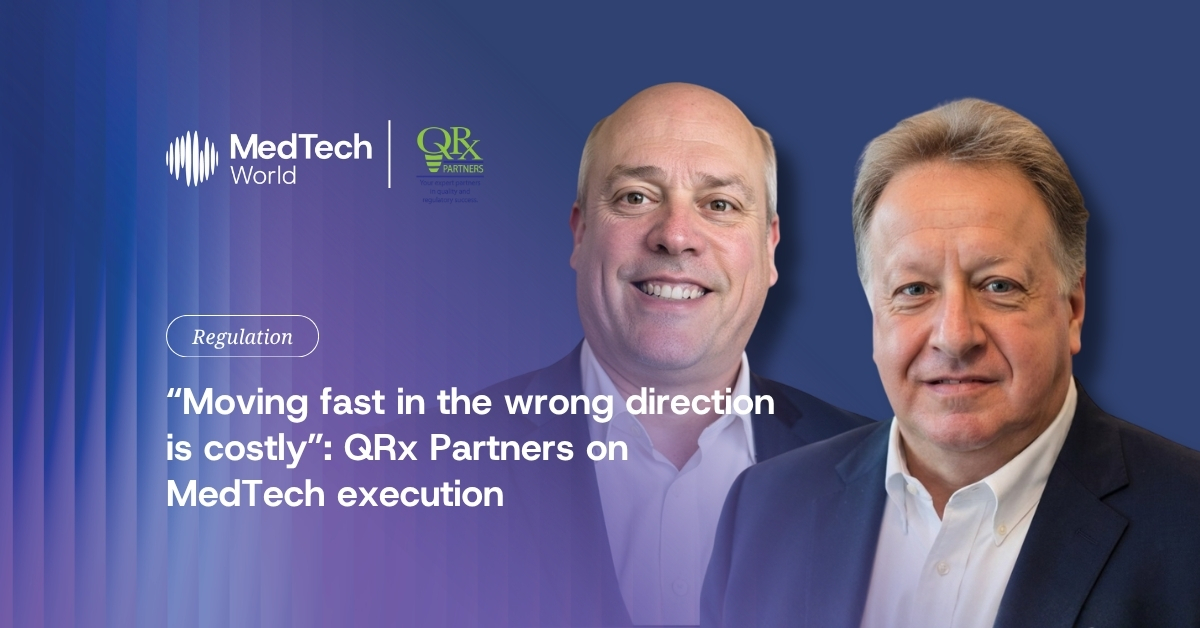
MedTech World spoke with Mark Swanson and Steve Gompertz, both Partners at QRx Partners, to discuss the challenges startups commonly face, how regulatory pathways influence fundraising and execution, and the broader trends emerging across today’s MedTech environment.
According to Swanson, one of the most common challenges for seed-stage companies is a limited understanding of how regulations directly influence the pathway to approval. He noted that selecting the right pathway can significantly affect timelines, costs, and the overall complexity of the process.
Gompertz added that many early-stage companies struggle with “uncertainty and overconfidence at the same time,” often underestimating the complexity of regulatory expectations. This can lead to weak regulatory strategies, incorrect classifications, and quality systems that look adequate on paper but fail operationally.
“A compliant QMS that doesn’t work operationally is worse than no QMS at all.”
Both partners emphasised that defining a regulatory and quality management roadmap early is increasingly critical, particularly as startups enter fundraising discussions. Investors today are paying close attention to regulatory risk and expect companies to demonstrate a clear understanding of timelines, costs, evidence requirements, and commercialisation pathways.
“Without it, uncertainty increases, and confidence declines,” Gompertz explained, referring to the absence of a defined roadmap.

Swanson also highlighted that investors in the current funding environment want visibility into the regulatory pathway as a means of de-risking their investment. QRx Partners supports this process by outlining detailed steps, approximate timelines, and activities that can run in parallel to help companies plan more effectively.
When discussing FDA approval pathways, both partners pointed to factors such as intended use, risk classification, predicate availability, and clinical evidence requirements as key considerations. Swanson noted that the presence of predicates or whether a device is considered novel can substantially change the route to approval and the work involved.
At the same time, both stressed that speed should not come at the expense of long-term scalability or compliance. Gompertz summarised the balance succinctly by stating that “moving fast is valuable; moving fast in the wrong direction is costly.”
The conversation also explored broader industry trends. Swanson pointed to the growing presence of connected and “smarter” medical devices capable of transmitting patient data, as well as combination products involving hardware, software, and drugs. He also noted the continued rise of software-as-a-medical-device and the increasing use of AI across the industry.
Gompertz observed that regulators across sectors are demanding stronger justification behind company decisions, not simply documentation. He added that medical device companies are facing deeper expectations around integrated risk management and post-market surveillance, while in-vitro diagnostics continue adapting to evolving global frameworks.
On the services side, both partners noted growing demand for regulatory strategy and FDA interaction support, especially among companies preparing for Pre-Submissions and formal FDA submissions. Swanson added that later-stage companies are increasingly focused on expanding their quality management systems and strengthening internal expertise as they move closer to commercialisation.
The partners also stressed that Pre-Submission meetings with the FDA are highly strategic interactions, not informal conversations. Asking broad or poorly framed questions can result in significant delays, expanded study requirements, and additional costs.
Gompertz shared an example of a company that approached the FDA before engaging QRx Partners and asked an open-ended question about the type of clinical evidence the agency would like to see. The FDA subsequently recommended lengthy human clinical trials. According to QRx Partners, their preferred approach would have been to first develop a structured clinical strategy and present it to the FDA for targeted feedback.
The discussion also highlighted the importance of QRx Partners’ experience with standards such as ISO 13485, ISO 9001, and ISO 14971. Gompertz explained that understanding the intent behind standards, rather than simply treating them as checklists, allows the firm to build systems that are both compliant and practical.
Swanson similarly noted that this experience enables the team to guide clients toward alternative pathways that can help reduce both time to market and overall costs.
A recurring theme throughout the discussion was the firm’s collaborative approach. Both partners emphasised that QRx Partners aims to work alongside clients rather than create dependency.
“Our approach is to help, teach and make our clients eventually not need help anymore,” Swanson shared, noting that many MedTech founders are navigating FDA processes for the first time.

Gompertz described the model as one focused on building long-term capability within client teams while also creating an ecosystem of external expertise when needed. He added that the word “Partners” in the company’s name reflects the way the firm integrates with clients and collaborates with specialists across design engineering, reimbursement, clinical trials, and related areas.
The interaction also touched on how startups perceive the FDA. Swanson explained that many founders approach the agency with unnecessary fear or misunderstanding, despite the FDA’s broader goal of supporting innovation, improving patient outcomes, and lowering healthcare costs. He pointed to mechanisms such as Pre-Sub/Q meetings as valuable opportunities for startups to communicate directly with regulators and gain clarity before formal submissions.
Gompertz added that companies often lose credibility through unclear communication, incomplete responses, or unsupported claims, stressing that the FDA remains fundamentally evidence-driven.
Looking ahead, both partners advised emerging MedTech companies to begin regulatory and quality planning as early as possible. Rather than viewing quality systems and regulatory strategy as late-stage obligations, they argued that these elements should be treated as enablers of execution speed, operational readiness, and investor confidence.
As Gompertz concluded, innovation in MedTech rarely fails because of weak ideas alone. More often, the challenge lies in execution — a gap that firms like QRx Partners aim to help startups navigate from the outset.
Be part of MedTech World North America 2026, taking place May 11–13, and connect with the people building and backing the next wave of MedTech companies.
Explore the agenda and book your ticket now to avoid the last-minute rush.