- Summits
- Sponsorship
- Retreats
- Media Opportunities
- News
- About
As MedTech companies look toward the Middle East for growth in 2026, many arrive with momentum, funding, and urgency. Fewer arrive with the strategic discipline required to operate within healthcare systems where regulation, procurement, and clinical adoption are tightly connected.
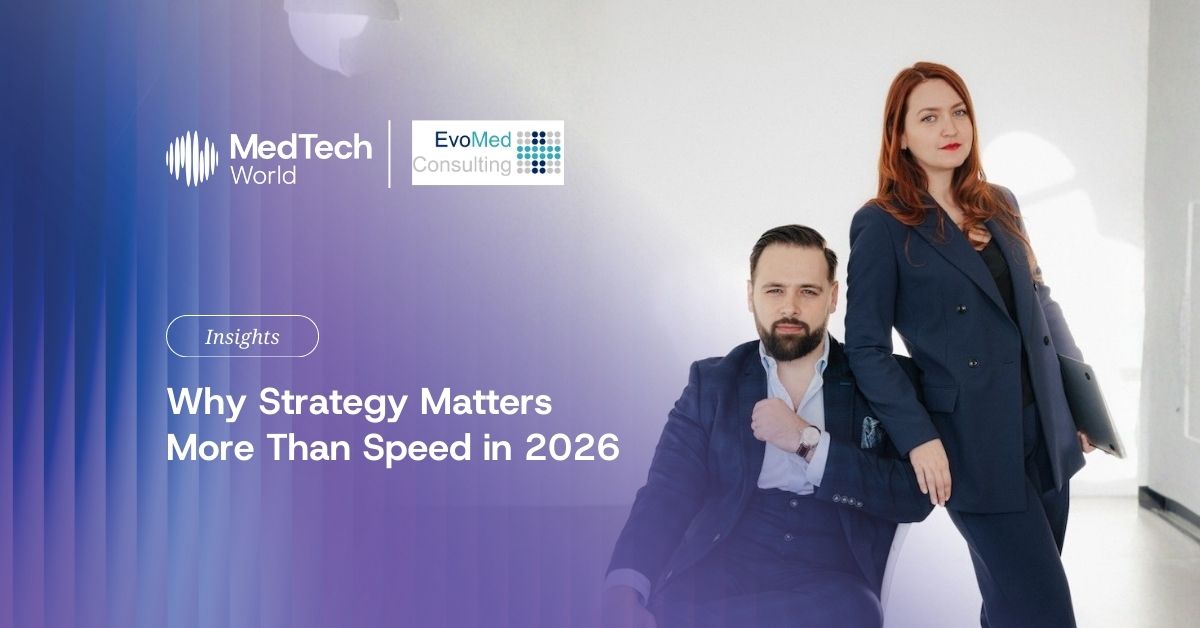
According to Dr. Amel Havkic, Founder and CEO of EvoMed Consulting, this imbalance is where most expansion efforts begin to unravel.
“Speed gets you to the wrong destination faster,” Amel explains. “Strategy gets you to market with a solution that survives reality: clinical workflow constraints, procurement logic, and regulatory expectations. In the GCC, winners won’t be the fastest movers. They’ll be the teams that sequence evidence, regulation, and adoption correctly.”
In markets such as the UAE and the wider GCC, speed without sequencing doesn’t create advantage. It compresses failure.
Many MedTech teams assume international expansion fails due to slow execution. In practice, EvoMed sees the opposite problem more often.
“Execution problems are visible; strategic ambiguity is silent—and far more expensive,” Dr. Amel says.

“Teams often execute flawlessly on unclear assumptions: who the buyer is, how adoption happens, or what evidence truly matters. They don’t fail because they moved slowly; they fail because they moved confidently in the wrong direction.”
This is particularly relevant in the Middle East, where healthcare decisions involve multiple stakeholders and long planning cycles. Misaligned assumptions may not trigger immediate rejection, but they surface later as stalled pilots, delayed procurement, or limited clinical uptake.
For Andra Havkic, COO of EvoMed Consulting, successful go-to-market strategies in the GCC require a fundamental shift in mindset.
“In the GCC, go-to-market success isn’t about aggression—it’s about alignment,” Andra notes.

“Decisions are multi-stakeholder, credibility is non-negotiable, and operational readiness is expected from day one.”
Approaches borrowed from consumer tech or fast-scaling software often fail in healthcare environments built on trust and continuity. “Teams that arrive with a ‘move fast and break things’ mindset don’t break the system,” she adds. “They break trust. And trust is the real currency here.”
EvoMed’s approach is shaped by Amel’s clinical background, including years in intensive care environments. That perspective informs how the firm evaluates market-entry readiness.
“Clinicians don’t buy features; we buy reliability under pressure,” Dr. Amel explains. “My ICU background trained me to spot failure points others miss—handoffs, cognitive load, workflow friction.”
When advising on GCC entry, EvoMed starts with a simple but revealing question: Where does this live in the care pathway, and what happens at 2 a.m.?
“That’s where adoption is won or lost,” Dr. Amel says.
This clinician-first lens helps surface issues that rarely appear in pitch decks but often determine whether a product is used consistently after approval.
One of the most common strategic blind spots EvoMed encounters is the assumption that regulatory approval equals success.
“Most MedTech teams treat regulatory approval as the finish line,” Dr. Amel says. “In reality, it’s just permission to start proving value.”
Regulation answers whether a product can be sold. Market access determines whether it will be paid for. Clinical adoption decides whether it will be used at all. When these elements are misaligned, companies may enter the market with an approved, purchasable product that no one touches.
“When they are aligned, each milestone strengthens the next,” Dr. Amel adds. “That’s when scale becomes repeatable.”
With regulatory frameworks continuing to evolve across the Middle East, EvoMed emphasizes that submissions should be treated as an output, not a starting point.
“The real work happens earlier,” Dr. Amel explains. “Precise intended use, realistic risk management, usability grounded in actual care settings, and a credible evidence plan. When those foundations are solid, regulatory processes become disciplined, not desperate.”
This preparation reduces late-stage revisions, unexpected evidence gaps, and delays that often erode early momentum.
Even after approval and procurement, sustained adoption remains fragile.
“Adoption is behavior change, not a checkbox,” Andra says. “If training feels burdensome, if integration adds clicks, or if value isn’t proven locally, clinicians disengage quietly.”
In this context, workflow fit becomes as critical as technical performance. Approval may open the door, but daily usability determines whether teams stay.
EvoMed’s digital content and strategic tools are designed to support, not replace, in-market engagement.
“Digital-first isn’t about replacing relationships,” Andra explains. “It’s about pre-building trust. It clarifies your thinking, educates stakeholders early, and attracts partners who already understand your value.”
By the time in-person discussions take place in markets such as the UAE, conversations can begin with alignment rather than explanation. “Digital builds the runway,” she says. “Presence lands the plane.”
Looking ahead, Amel sees a clear pattern among MedTech companies that scale successfully in the Middle East.
“The next wave of winners won’t be defined by better technology, but by fewer assumptions,” he says. These include solutions designed for real clinical workflows, demand for measurable outcomes and economic clarity, and teams that treat adoption friction as a strategic risk rather than an afterthought.
As a panelist at MedTech World Middle East | Dubai 2026 speaking on the panel “Navigating Regulatory Pathways & Market Access Strategies for MedTech”, Amel’s advice to founders is direct:
“Don’t enter the GCC to expand; enter to fit. Design for real clinical workflows, align regulation with market access early, and treat implementation as part of the product.”
He concludes with a perspective that defines EvoMed Consulting’s work:
“Great MedTech doesn’t fail because it lacks innovation. It fails because strategy ignored clinical reality. When adoption, regulation, and market access are treated as one system, scale stops being a gamble and becomes a consequence.”
The conversation around regulatory strategy, market access, and clinical adoption continues at MedTech World Middle East | Dubai 2026, taking place from 11 to 13 February.
If you’re navigating growth in the region or planning your next market move, book your tickets now and be part of the discussions shaping how MedTech scales in the Middle East.