- Summits
- Sponsorship
- Retreats
- Media Opportunities
- News
- About
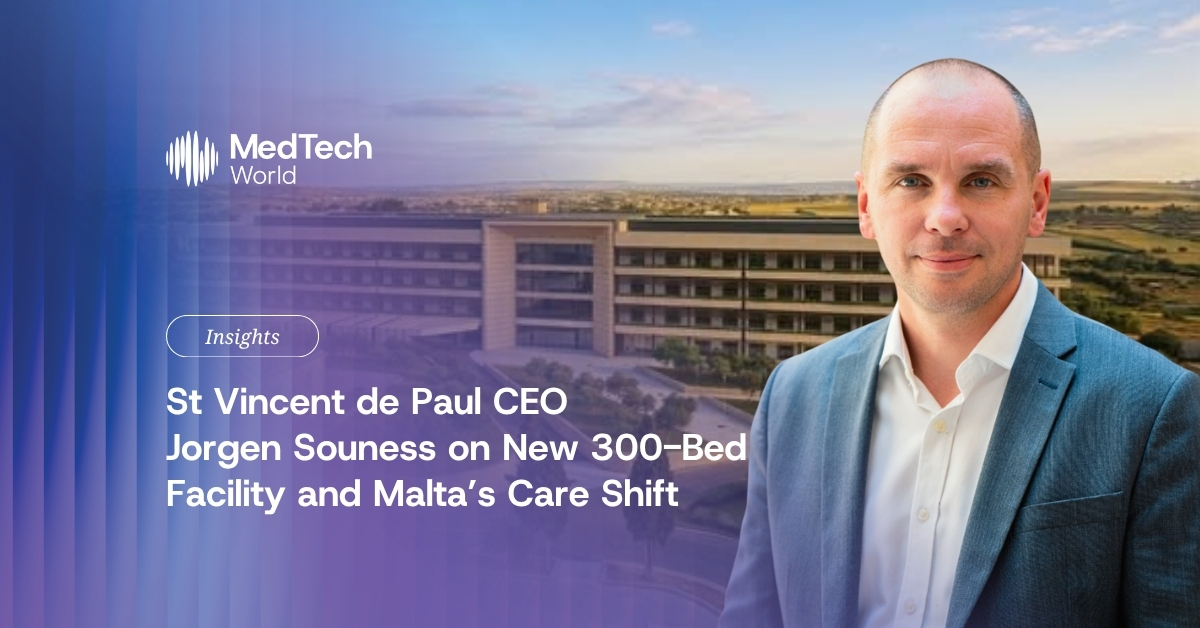
Malta’s healthcare system is preparing for a more structured approach to recovery and elderly care, following the tendering of a new 300-bed intermediate care facility at St Vincent de Paul Hospital. Designed as a long-term build, operate and maintain project over 30 years, the development signals a clear move toward strengthening the space between acute treatment and long-term support.
For Jorgen Souness, CEO, St Vincent de Paul, the initiative reflects both a practical response to system pressures and a broader rethink of how care should be delivered to an ageing population. At an institutional level, it reinforces the hospital’s role as a central provider of specialised services for older persons and those who require continued clinical support beyond the acute phase. More importantly, it expands the hospital’s ability to deliver structured intermediate care that sits between hospital treatment and home or residential care.
That gap has long shaped patient flow across Malta’s system. Patients discharged from acute care settings, such as Mater Dei Hospital, are often medically stable but not yet ready to return home, requiring rehabilitation, nursing, or supervised recovery. In the absence of dedicated facilities, this has typically led to extended stays in acute settings or transitions that are not always well-timed. The new facility is intended to change that dynamic by creating a dedicated environment for both step-down and step-up care, allowing patients to move more appropriately through the system.
The implications extend beyond capacity. By enabling smoother transitions, the model is expected to improve patient flow, reduce unnecessary hospital stays and admissions, and allow acute care resources to be used more effectively. At the same time, it introduces a more deliberate recovery pathway, where discharge is not treated as a final step but as part of a coordinated process that continues beyond the hospital ward.
For St Vincent de Paul, this marks a shift in how elderly care is approached. Souness points to a move away from a traditional long-term care model toward one that is more person-centred and integrated, with a stronger focus on rehabilitation, reablement, and maintaining independence. The addition of an intermediate care layer allows for a more balanced continuum, where care can be adjusted to match each patient’s clinical and functional needs as they progress.
This approach also reshapes the patient experience. Instead of remaining in high-intensity hospital environments or returning home prematurely, older adults are able to recover in a setting designed specifically for their stage of care. With access to multidisciplinary support and personalised rehabilitation, the focus shifts toward gradual recovery and functional improvement, which in turn reduces the likelihood of readmission and supports more stable long-term outcomes.
Technology is expected to play a central role in enabling this model. The facility is likely to incorporate integrated electronic health records to support continuity across care settings, along with digital rehabilitation tools and remote monitoring systems that allow clinicians to track patient progress in real time. Data-driven care pathways and decision-support tools are also expected to support more consistent and informed clinical decisions, while reducing administrative burden on staff. Over time, AI-enabled systems may further enhance monitoring and operational planning, particularly in managing the complex and evolving needs of elderly patients.
The broader impact on Malta’s healthcare infrastructure could be considerable. By creating a dedicated space for patients who no longer require acute treatment, the facility allows hospitals like Mater Dei to focus on higher-acuity cases, easing congestion across emergency and admission pathways. At the same time, it strengthens continuity of care by ensuring that patients continue to receive appropriate support as they move through different stages of recovery.
Souness also sees the project as an opportunity to engage more closely with the MedTech and digital health community. As the facility takes shape, there is clear scope for collaboration around technologies that can support monitoring, rehabilitation, and data-driven care delivery in real-world clinical settings. The emphasis is on solutions that are practical, scalable, and capable of improving both patient outcomes and system efficiency.
As Malta continues to respond to the realities of an ageing population, the new intermediate care facility at St Vincent de Paul Hospital reflects a more deliberate and balanced approach to care delivery. It is a shift that places equal weight on recovery and independence as it does on treatment, one that aims to ensure patients receive the right level of care, in the right setting, at the right time.
The latest developments in healthcare and MedTech will take centre stage at MedTech World North America 2026.
Taking place on May 11 to 13, 2026, in West Palm Beach, Florida, the event brings together founders, investors, healthcare leaders, and innovators driving new approaches in care delivery, digital health, and medical technology.
This is the last call to secure your ticket. With limited availability remaining, now is the time to be part of the conversations defining what comes next in healthcare.
Be in the room where these conversations happen. For any queries, please connect with the team at [email protected].