- Summits
- Sponsorship
- Retreats
- Media Opportunities
- News
- About
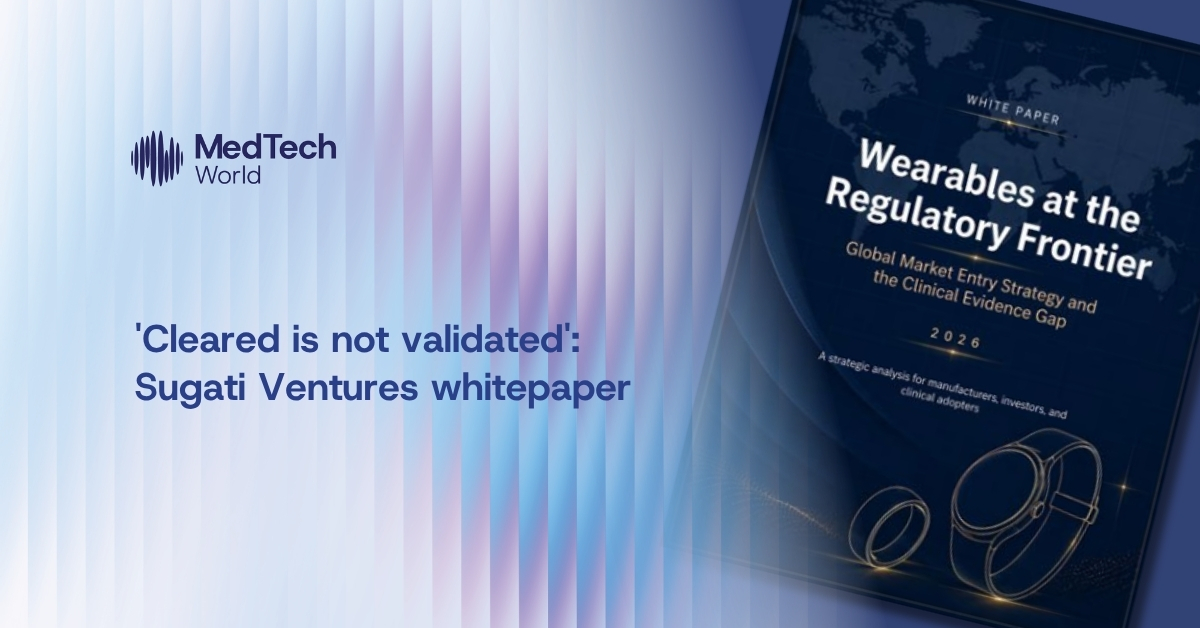
A new white paper from Sugati Ventures delivers a pointed message to the healthcare wearable industry: the regulatory strategies that fuelled a decade of rapid growth are losing their effectiveness, and companies that have not invested in genuine clinical evidence are facing a reckoning.
Titled Wearables at the Regulatory Frontier: Global Market Entry Strategy and the Clinical Evidence Gap, the 2026 paper is authored by Emily Hu, Advisor at Sugati Ventures, and Rachna Dayal, Managing Partner at Sugati Ventures. It is framed as a strategic guide for manufacturers, investors, and clinical adopters, but its core argument is a diagnosis of a systemic problem running through the entire industry.
The paper’s foundational insight is deceptively simple: a wearable’s regulatory classification is not determined by what the device does, but by what the manufacturer claims it does. The same wrist sensor can be a consumer wellness product, an FDA-cleared medical device, or a regulated Software as a Medical Device (SaMD) depending entirely on how the company positions it. This distinction, Hu and Dayal argue, has driven a decade of strategic claim engineering — companies carefully keeping their product language just below the threshold of FDA oversight while aggressively marketing health-adjacent benefits. That window, the paper argues, is closing.
To ground the analysis, the paper profiles four devices representing the full regulatory spectrum.
The paper identifies three common regulatory arbitrage strategies: pursuing US 510(k) clearance first and EU MDR later; running lower-cost clinical trials in Asia-Pacific markets to build global evidence packages; and launching as a wellness device before seeking medical clearance. Each carries legitimate commercial logic. Each also carries risks the paper documents with precision, from the EU MDR’s maturing enforcement teeth, to the methodological trap of APAC trial populations that may not generalize to Western patients, to the liability exposure of wellness-classified devices used for real medical decisions.
The paper’s most consequential argument is its simplest: FDA 510(k) clearance confirms substantial equivalence to a predicate device. It does not confirm clinical effectiveness. Payers, particularly CMS, are now demanding the latter, and emerging as the industry’s most consequential evidence enforcement mechanism. The pulse oximeter accuracy disparity across skin tones, a years-long cleared-device failure with documented patient harm, is the paper’s starkest case study of what the evidence gap can cost in practice.
Hu and Dayal’s conclusion is both a warning and a strategic prescription. Clinical evidence is not a regulatory compliance cost; it is the most important competitive investment a wearable company can make. With EU MDR enforcing rigour, FDA tightening digital health scrutiny, and payers raising the bar for coverage, the companies building durable market positions are those that treated evidence generation as a strategic asset from day one.
Taking place from 26 to 28 August, MedTech World Asia 2026 at the Hong Kong Convention and Exhibition Centre is the right room for this conversation. Hong Kong is the only city in Asia combining Western legal trust, direct China market access via CMPR 2026, GBA manufacturing reach, and a capital market with 1,500+ VC funds and the world’s #1 ranked exchange for biotech IPOs. If your Asia regulatory strategy is still taking shape, this is where it gets decided. Book your spot now.