- Summits
- Sponsorship
- Retreats
- Media Opportunities
- News
- About

At MedTech World North America 2026, investors and banking leaders came together for a candid discussion on what is shaping MedTech financing in 2026, where capital is flowing, and what founders continue to underestimate when trying to raise money or position themselves for acquisition.
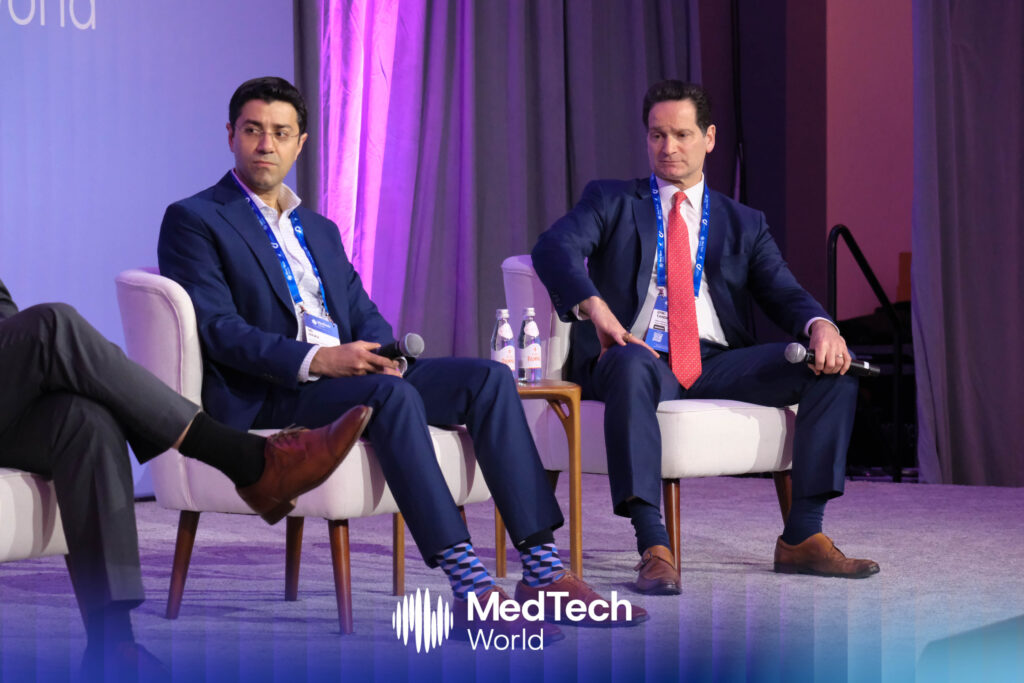
Moderated by Steven Levy, Partner at Unorthodox Ventures, the panel featured Greg Madden, Managing Partner at SV Health Investors, Chris Japp, Partner at Tramway Ventures, Sid Arora, Vice President, Healthcare Investment Banking at Ernst & Young Capital Advisors, and Eric Tansky, Head of Medical Technology Banking at Oppenheimer & Co. Inc.

The conversation moved beyond broad market optimism and focused instead on the practical realities investors are evaluating today: reimbursement strategy, usability, workflow integration, IP protection, valuation discipline, and the long path to acquisition.
Opening the discussion, Steven Levy asked the panel how they evaluate different forms of risk when investing in MedTech companies, including clinical, commercialization, market access, funding, and intellectual property risks.
For Greg Madden, clinical validation alone is no longer enough.
“Clinical is table stakes,” he said, explaining that technologies must not only demonstrate efficacy and secure approval, but also prove practical in real-world use. He pointed to surgeon usability and reimbursement as two factors that ultimately determine whether a product reaches meaningful adoption.
“Everything follows payment,” Madden noted, emphasizing that even strong technologies struggle without a clear reimbursement pathway.
He also stressed that execution across those areas depends heavily on leadership quality and operational capability.
Chris Japp, whose firm focuses more heavily on earlier-stage opportunities, encouraged founders to think about acquisition strategy far earlier than many typically do.
“We look for an exit between five to ten years,” he said, adding that founders should already be considering which strategic buyers may eventually acquire the business and why.
That long-term thinking, he suggested, can influence everything from product development to commercial positioning.
A recurring theme throughout the discussion was market access and reimbursement strategy, particularly for early-stage companies.
Madden explained that investors do not necessarily expect founders to have every reimbursement answer immediately, but they do expect a credible roadmap.
“When I’m looking at early-stage companies, I want to see a strategy,” he said. “I don’t necessarily need to see the answer, but there has to be a well-thought-out roadmap.”
The panel agreed that reimbursement planning can no longer be treated as a downstream activity. Instead, it increasingly shapes investor confidence from the earliest financing rounds.
Sid Arora advised companies to engage reimbursement experts early during device development and prepare multiple scenarios in case initial pathways fail.
“Thinking of all these options on hand can help you get to the end goal faster,” he said.
Eric Tansky offered a more direct assessment from the banking perspective.
“No reimbursement, no business,” he said plainly.
He argued that MedTech companies either need to confidently leverage existing reimbursement codes or generate clinical evidence compelling enough to make reimbursement highly likely. Otherwise, he suggested, many deals simply become difficult to finance.
The discussion reflected a broader shift across the industry, where reimbursement readiness is increasingly viewed as a core component of company value rather than a late-stage operational hurdle.
Beyond reimbursement, panelists also emphasized the importance of designing products that fit naturally into clinical workflows.
Japp explained that many technically impressive innovations still struggle because providers are reluctant to disrupt established routines.
“There’s got to be some thinking behind how this is going to be used day to day and how easy it is to do,” he said.
He noted that workflow friction often directly affects adoption speed, commercialization costs, and ultimately investor appetite.
The conversation highlighted a growing expectation among investors that founders must think beyond invention itself and demonstrate how technologies integrate into healthcare systems already under operational pressure.
The panel also explored how valuation expectations are evolving in a more selective financing environment.
Madden cautioned that inflated early-stage valuations can create problems later if companies require multiple financing rounds.
“A high valuation can be the kiss of death,” he said, warning that unrealistic pricing may lead to difficult down rounds or limit future financing flexibility.
At the same time, he acknowledged that companies with exceptional clinical or economic value propositions can sometimes justify valuations above their peers.
Chris Japp described valuation discussions as one of the most difficult parts of structuring early-stage deals.
If valuations are too low, companies may struggle to attract future syndicates. If too high, they risk future financing complications and unrealistic expectations.
For Eric Tansky, the issue often becomes most visible when companies compare themselves to outlier success stories without sufficient commercial evidence.
“You can look at where M&A deals are happening,” he said, pointing out that acquisition benchmarks across MedTech categories remain relatively transparent.
He warned that pre-revenue companies pursuing extremely high valuations without clear scalability or commercialization traction may ultimately become difficult to finance.
Sid Arora echoed those concerns, encouraging founders to focus first on proving scalability, reimbursement viability, and commercial traction before pushing for aggressive valuations.
“It’s better to wait in such scenarios versus going full steam ahead,” he said.
While the discussion covered financing strategy, reimbursement, commercialization, and acquisitions, the broader message across the panel remained consistent: MedTech capital in 2026 is increasingly flowing toward companies that demonstrate operational clarity rather than ambition alone.
Investors are still looking for innovation, but they are also looking for realistic commercialization pathways, disciplined financial planning, strong reimbursement strategies, and technologies that solve problems within existing healthcare workflows.
The conversation reflected a market environment where execution, timing, and strategic alignment are carrying greater weight than headline valuations or early excitement alone.
Couldn’t make it to MedTech World North America 2026? Watch this session and other highlights from the day on the official YouTube channel of MedTech World.