- Summits
- Sponsorship
- Retreats
- Media Opportunities
- News
- About
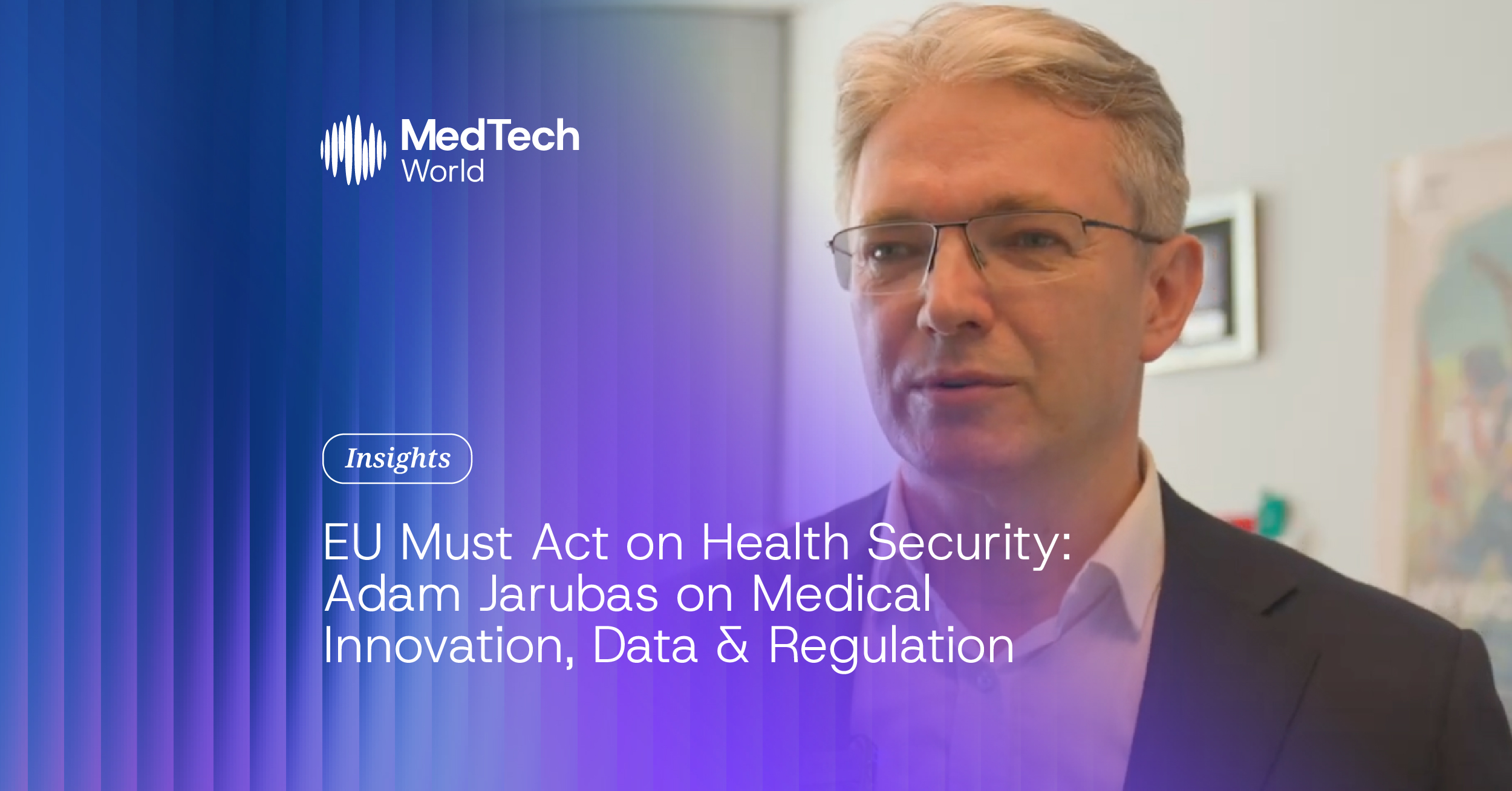
In a recent interaction with MedTech World, Member of the European Parliament and Chair of the European Parliament’s Standing Committee on Public Health (SANT) Mr Adam Jarubas spoke openly about the European Union’s renewed focus on healthcare policy and innovation. Drawing on lessons from the pandemic and current geopolitical tensions, Jarubas highlighted the growing need for cross-border cooperation, data integration, and regulatory reform across the EU’s health landscape.
“The Health Committee has started its work in January this year, but you could say that it was a very important impulse that made us realize how important it is to cooperate in health was the pandemic,” Mr Jarubas said.
“We changed our thinking, we realized that by working together, we can create more effective health care systems.”
Also read: Changing landscape of medtech regulation: What notified bodies are facing now
According to Jarubas, the pandemic and ongoing war have shown just how fragile and interdependent Europe’s health systems really are. “The pandemic has also shown that through collaboration, we can make joint purchases instead of competing with each other in terms of price for limited resources,” he said.
That experience—of joint procurement and shared urgency—has led to a broader consensus among EU leaders. “So both the pandemic and the war today are making it clear that having more European integration in health and security is the right approach.”
Also read: Cybersecurity is patient safety: Blue Goat Cyber’s mission to secure medtech
At the heart of Jarubas’s message is the need for Europe to reclaim strategic autonomy in pharmaceuticals and medical devices. “Medical, pharmaceutical, and health security form a crucial component of our overall security framework,” he said. “Today, there’s a strong consensus within European Union that we should strengthen our common health policy.”
He pointed to Europe’s current dependency on global supply chains as a clear risk: “The dependencies we’ve developed over recent years from Asia, China and India reveal that Europe must achieve pharmaceutical independence and autonomy.”
This independence extends beyond pharmaceuticals. “The same applies to technology [and] medical devices,” Mr Jarubas added.
To support this goal, the EU is backing homegrown innovation with major funding mechanisms. “We want to foster better conditions for technologies to flourish here, dedicating more funding through EU programs. Up to now, this has been through Horizon Europe, a program designed for research and development. We aim to maintain at least these funding levels in the next cycle.”
Also read: Medtech market in France hits €37B: Innovation and global ties grow
Jarubas also underscored the significance of the recently adopted European Health Data Space Regulation. “This represents a tremendous boost for healthcare innovation, for research and development networks, and for us as patients when we travel across Europe. Our data will move with us. This is an excellent piece of legislation,” he said.
Yet the promise of integrated data will take time to implement. “Naturally, a full implementation will require an estimated minimum of 5 years. We will need an upgraded infrastructure, software, hardware plus new competencies for the medical staff. But for progress, this is absolutely fundamental.”
One area of increasing concern across the MedTech ecosystem is the regulatory pressure on small and medium-sized companies. Jarubas acknowledged the growing frustration. “We are now hearing from the market, particularly from small and medium enterprises in the medical device sector that the current regulations are proving onerous for businesses.”
The certification bottleneck is especially evident. “We have only 27 bodies authorized to certify these technologies for patient use.”
He confirmed that policymakers are paying attention. “There is a growing expectation that the Commission will review the medical devices regulation. This might even happen through some form of expedited process to streamline procedures and lower costs that companies face for certifying and recertifying the solutions our citizens rely on.”
At the core of this effort is a belief that health innovation should not be obstructed by unnecessary delays. “We should clearly do whatever it takes to smoothen the path, where there are ideas and innovations that can benefit patients, they need to reach the market as quickly and efficiently as possible, while maintaining safety standards. That’s why I’m confident this review and any new regulations will keep patient health firmly at the center of everything.”
Taking place from 12 to 14 November in Valletta, MedTech World’s flagship event brings together global leaders in healthcare, medical technology, investment, and policy for three days of strategic insights, networking, and collaboration. Whether you’re a founder, policymaker, investor, or industry expert, Malta is where partnerships are formed and breakthroughs are launched. Get your tickets today!
Interested in sponsoring, speaking, exhibiting, or simply learning more about MedTech Malta 2025? Reach out to us at [email protected] and let’s explore how you can be part of the movement.