- Summits
- Sponsorship
- Retreats
- Media Opportunities
- News
- About
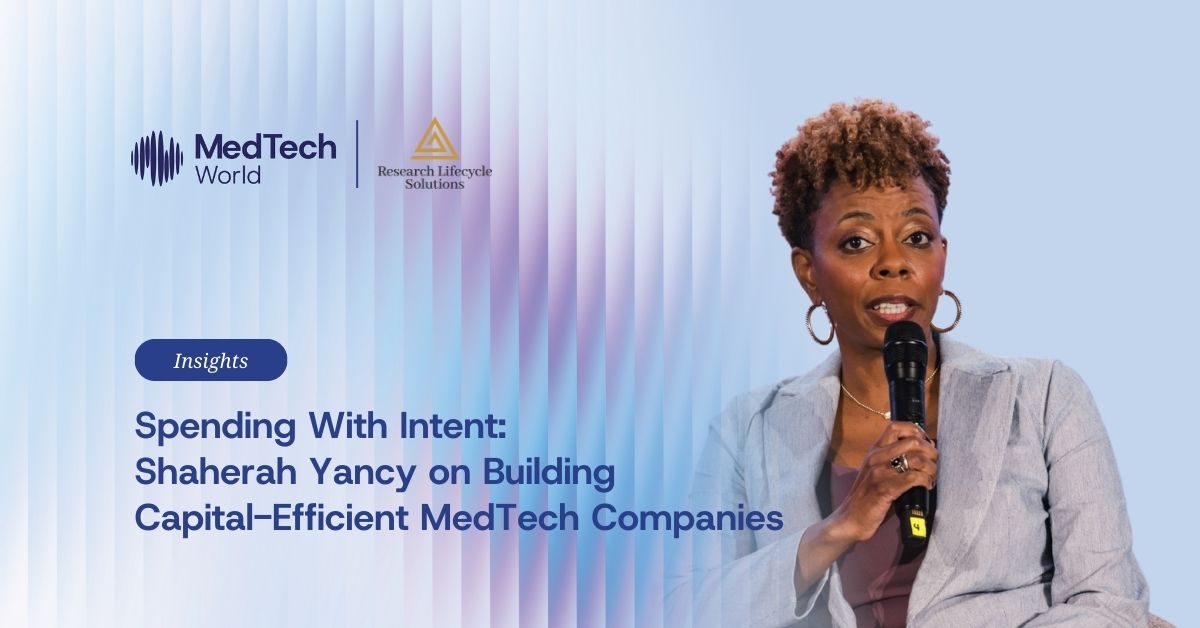
In a funding environment where scrutiny is high and capital is harder to secure, early-stage MedTech and life sciences founders are increasingly rethinking what capital efficiency really means. For Shaherah Yancy, CEO of Research Lifecycle Solutions, the answer is clear: efficiency is not about spending less, but about spending with intent.
Speaking to MedTech World following her participation on the panel ‘Limited Funds: How Do We Succeed?’ at MedTech Malta 2025, Yancy shared a grounded perspective shaped by years of working with founders navigating regulatory, clinical, and commercial complexity. Her message consistently returned to one point: without upfront strategic clarity, even well-funded startups can lose time, money, and credibility.
Many founders, particularly first-time CEOs, equate capital efficiency with conserving cash. Yancy challenges this assumption directly.
“Many founders mistake capital efficiency for spending less, when in reality it’s about spending with intent,” she explained.
“In early MedTech and life sciences, true capital efficiency means investing early in a clear strategy—regulatory, clinical, and commercial—so every dollar drives data-backed decisions, reduces downstream rework, de-risks timelines and resources, and strengthens future raises.”

In practice, this means founders should stop viewing strategy as a luxury reserved for later stages. Instead, strategic planning should be one of the earliest investments, shaping how capital is deployed from day one.
“When your roadmap is aligned,” Yancy added, “you move faster, waste less, and earn investor confidence.”
Intentional spending, according to Yancy, requires founders to take responsibility for assigning purpose to capital before it is deployed.
“Every dollar you raise should have a specific job tied to a clear decision or milestone,” she said.
“That responsibility is proactive. You assign purpose to capital before it’s spent, rather than reacting in hindsight when money is already gone.”
Too often, intentionality is learned through costly missteps. Disciplined teams, however, define upfront what each dollar must unlock—be it regulatory clarity, clinical evidence, or market validation—before committing spend.
One of the most consistent pitfalls Yancy sees is the delay of commercial planning until after product development or fundraising is already underway. She argues that this sequencing is backwards.
“A commercialisation blueprint should be developed early because hindsight shouldn’t be the only way founders gain 20/20 vision,” she noted.
“Just like an architect wouldn’t hammer the first nail without a blueprint, founders shouldn’t build products or raise capital without clarity on what they’re building, why it matters, and what it will take to reach market.”
An early blueprint aligns development, evidence generation, and capital strategy, preventing the need for costly course corrections later.
A well-defined commercial roadmap does more than guide go-to-market planning. It ensures product development reflects real-world use, regulatory expectations, and reimbursement realities.
“When these elements are aligned early, design inputs reflect how the device will actually be used at the point of care,” Yancy explained. “Whether it simplifies or disrupts workflow, and how usage and outcomes support payer requirements.”
When handled in isolation, the risks multiply. Startups often discover too late, sometimes post-clearance, that their product is not adoptable, usable, or reimbursable as envisioned, leading to redesigns, delays, and lost capital.
Without a clear commercial roadmap, startups often fall into reactive spending patterns. Yancy sees this most commonly when speed to regulatory approval is prioritised over validating true market need.
“This often leads to fragmented teams and duplicated effort,” she said.
“Hiring the wrong consultants, defaulting to large brand-name firms without ensuring alignment to the company’s stage, and managing regulatory, clinical, and commercialisation in silos.”
Market expertise is then brought in too late to “rescue” the programme, resulting in rework that could have been avoided by integrating engineering, regulatory, and clinical strategy from the start.
In capital-constrained environments, Yancy believes upfront clarity delivers one of the highest returns a founder can make.
“A clear commercialisation blueprint defines the critical milestones, what evidence and resources are required, the capital needed, and a realistic timeline to market,” she said.
“That clarity enables proactive decision-making, reduces misallocated spend, and directly strengthens fundraising strategy.”
Rather than pitching assumptions, founders are able to align capital asks with credible, value-creating inflection points.
Yancy is emphatic that regulatory and clinical considerations are not downstream checkboxes, but strategic inputs that define the business model itself.
“Before the first fundraising conversation, founders need clarity on how their product will likely be classified, what evidence FDA and clinicians will expect, how long that evidence will take to generate, and what it will realistically cost,” she explained.
Too often, investors are presented with unvalidated assumptions.
“At the early stage, investors don’t fund ideas,” Yancy said. “They fund risk reduction.”
Clinical work is frequently viewed as a necessary expense. Yancy challenges founders to see it differently.
“Clinical evidence shouldn’t be viewed as a cost; it’s the most valuable asset a company can create,” she said. High-quality data supports regulatory claims, informs reimbursement, builds clinician trust, and underpins long-term enterprise value.
Intentional evidence generation means designing studies backwards from the decisions the data must support, rather than running trials in isolation. This approach reduces unusable data, avoids rescue studies, and preserves capital over time.
In today’s more cautious funding environment, a strong regulatory and clinical strategy shifts the investor narrative from vision to execution.
“Investors are looking for credible pathways, evidence plans, and realistic timelines,” Yancy noted. “That directly translates into faster clinician trust, smoother adoption, and fewer surprises post-clearance.”
For founders balancing fundraising, development, and evidence generation, Yancy offered straightforward guidance.
“Anchor every spend to a decision or milestone that reduces risk or increases value,” she advised.
“If a dollar doesn’t advance regulatory clarity, clinical evidence, or market readiness, it’s likely noise, not progress.”
One misconception Yancy is keen to dispel is the belief that speed equals efficiency.
“It’s highly common that founders believe getting market approval automatically enables revenue generation,” she said. Approval without adoption, reimbursement, or workflow fit does not create a business.
Her final message is a mindset shift many founders need to hear early.
“Value is built by intentional strategy, not reactive execution,” Yancy concluded.
“If founders believe they can’t afford a credible, expert-driven strategy, the reality is they can’t afford not to have one. Speed means nothing if you don’t know where you’re going, or how you’ll get there.”
Conversations around capital discipline, regulatory clarity, and commercial readiness will continue at MedTech World Middle East | Dubai 2026, where founders, investors, and industry leaders will gather to discuss how to build resilient, investable MedTech companies in today’s funding environment. Join the discussion and be part of the dialogue shaping practical pathways to market.