- Summits
- Sponsorship Plans
- News
- About
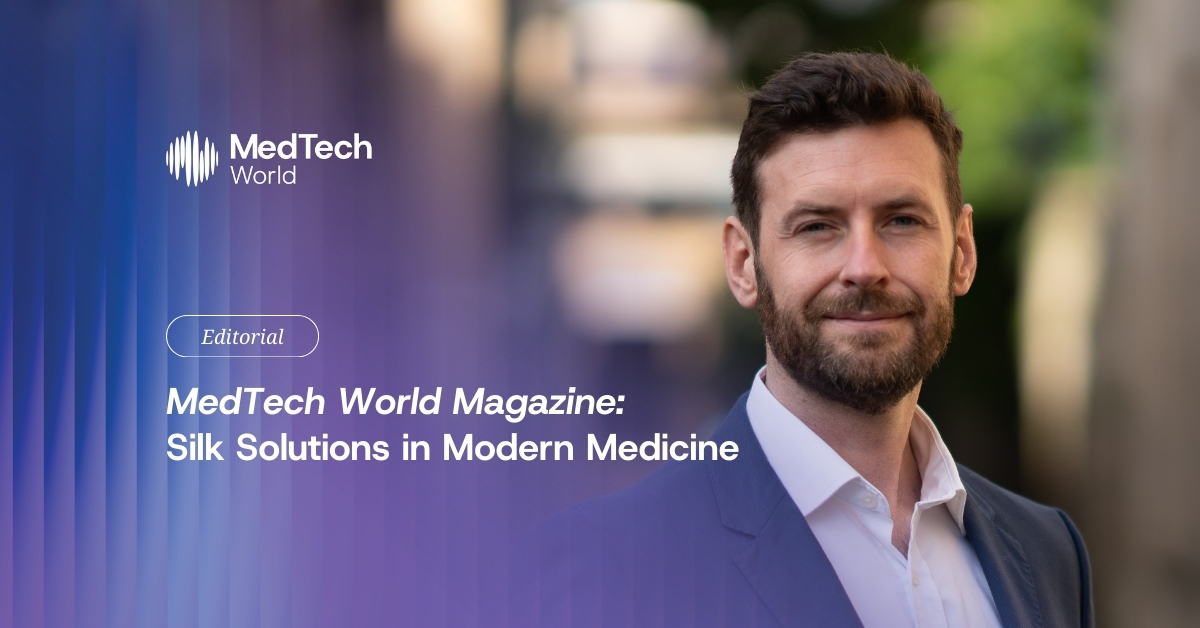
Long before polymers and precision engineering defined modern surgery, nature had already perfected materials of extraordinary strength and sensitivity. Today, that ancient wisdom is finding new relevance in operating theatres and research labs alike. In an industry constantly searching for safer, smarter solutions, one unlikely material — silk — is quietly emerging as a serious contender in the future of regenerative medicine.
Dr Alex Woods, the CEO and co-founder of Newrotex, brings a unique blend of expertise to the table. His journey, from conducting zoology research at Oxford University to practising as a trauma and orthopaedic surgeon, and now venturing into MedTech entrepreneurship, has significantly influenced the company’s vision to revolutionise patient care.
Dr Woods started his academic evolution with the acquisition of a D.Phil. in Zoology at Oxford, where he was part of the Oxford University spin out Oxitec, and later the Oxford Silk Group. This early exposure sparked his interest in the structure of silk biopolymers. Later on in his clinical practice, he discovered that many patients with horrible injuries, mainly related to nerve injuries, did not have promising treatment interventions available.
“Working as a Trauma and Orthopaedic surgeon in Oxford has given me a fairly helpful perspective for a MedTech start-up,” he explains.
Every day, I see how devastating injuries and degenerative conditions can be for patients, and how much unmet need there still is for better treatments.
The intersection of science and surgery made it inevitable that Newrotex would be created as a confluence of his love for biology and his desire to address pressing clinical concerns.
Silk has always been a material of interest to both scientists and clinicians. Its strength, biocompatibility, and inherent flexibility provide a level of versatility that synthetic materials cannot perfectly match.
“Silk isn’t just an alternative, it’s a platform for a whole new class of medical devices,” says Woods.
Unlike many biomaterials, silk integrates seamlessly with the human body. It provides both strength and delicacy, making it particularly suited for sensitive tissues such as nerves. Furthermore, silk’s resistance to gamma irradiation offers significant advantages for sterilisation, helping overcome challenges that often hinder the safe use of other biomaterials.
“Records show people putting cobwebs on wounds thousands of years ago to help them heal,” he adds. “We’re now taking that ancient principle and applying it with modern science.”
Newrotex, like many MedTech innovators, faced the difficult task of translating laboratory research into a scalable and regulatory-compliant solution. That would mean much, if not all, of their manufacturing processes would need to change while ensuring that innumerable hurdles of the regulatory landscape were both taken on and overcome.
“One of the biggest challenges has been bridging the gap between a brilliant idea in the lab and something that works safely, consistently, and scalably in real patients,” Woods reflects. The breakthrough moment came when the company achieved ISO 13485 certification and progressed into its first human studies, milestones that validated years of work.
Funding has also required a careful strategy. By securing non-dilutive grants and early-stage angel investment, Newrotex has been able to advance steadily while reducing investor risk and building confidence for the future.
Partnerships are ingrained in the company’s culture, and Woods believes that collaboration is essential to success in entrepreneurship, just as it is in surgery. “The innovation didn’t happen because I spent another hour looking at the screen; it happened because we were sitting around talking with team members and people we didn’t know, having a drink, and all of a sudden we figured out some good stuff,” Woods reflected on his Oxford lab experience.
“Our collaborative values are at the core of what Newrotex stands for.” The team involved in Newrotex work closely with researchers, clinicians, patients, and industry partners from the UK, US, and Europe. This kind of collaboration brings varying levels of scientific and clinical expertise to discussions to ensure its technologies remain clinically relevant, as well as robustly scalable and commercially viable. This collaborative approach will connect the reader to what it feels like to be part of a community working towards medical advances.
As regenerative medicine continues to advance, the role of silk-based devices is set to become increasingly significant. Dr Woods envisions vast potential in nerve repair and the reconstruction of complex tissues. Newrotex’s goal is not just to create new devices, but to demonstrate that nature-inspired technologies can redefine healthcare possibilities.
For Newrotex, the ultimate goal is clear: to restore quality of life for patients and set new standards for how science and nature can work together in modern medicine. This mission to improve patients’ lives and set new standards in healthcare makes the reader feel empathetic and connected to the company’s vision.
Get featured in MedTech World Magazine, a curated publication for senior decision-makers across the global MedTech ecosystem. Distributed at MedTech World’s flagship events, each edition extends on-stage conversations into practical industry insight.
Read this edition, or apply to be featured.