- Summits
- Sponsorship
- Retreats
- Media Opportunities
- News
- About
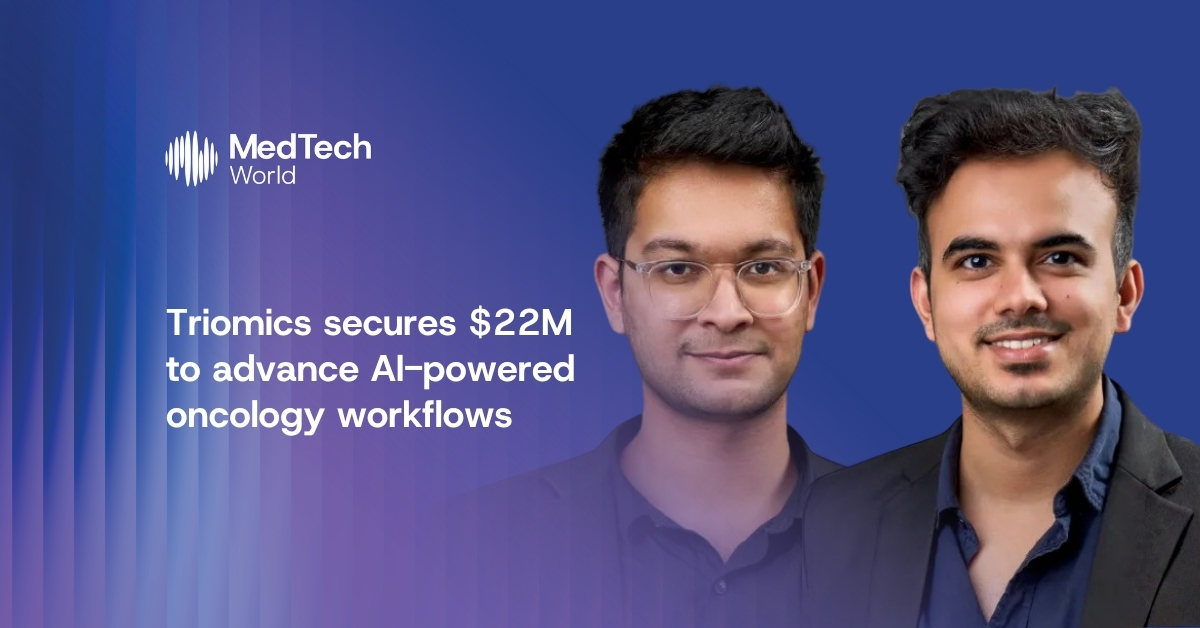
Oncology’s bottleneck has never been a shortage of data. A single patient history can span hundreds of clinic notes, pathology reports, biomarker results, and evolving trial criteria, yet the workflows to make that information usable have stayed stubbornly manual. Triomics, founded in 2021, was built to change that.
The New York-based oncology AI company has raised $22 million in Series B financing led by Battery Ventures, with participation from Nexus Venture Partners, Lightspeed, Y Combinator, and strategic backers Oncology Ventures and Precision Health Informatics. Total funding now exceeds $36 million.
“Oncology faces an information burden at a scale legacy systems were never designed to handle, and that burden can stand in the way of better outcomes. We built Triomics to turn that complexity into usable intelligence inside the workflow, purpose-built for oncology,” said Sarim Khan, co-founder and CEO of Triomics.
The company’s platform uses AI agents to read the full longitudinal patient record and convert unstructured clinical information into structured, verifiable outputs delivered directly inside existing workflows. Every output is source-backed, not a black-box summary. Three core use cases are live today: proactive clinical trial matching, pre-visit chart preparation, and oncology data abstraction for registries and quality programmes.
The results are notable. Published figures show a 40% increase in trial matches, 30%+ growth in trial enrolments, and a 67% reduction in chart review time. The platform has been validated in Nature Digital Medicine and presented at ASCO. The company is already working with leading cancer centres, including Memorial Sloan Kettering, MD Anderson, Yale Cancer Center and Smilow Cancer Hospital, Mount Sinai Tisch Cancer Center, and Texas Oncology.
“Oncology is the hardest place to build AI, yet the most important,” said Hrituraj Singh, co-founder and CTO, Triomics. “Getting a model to reason reliably across thousands of pages of notes, pathology, imaging, and evolving trial criteria, and show its work, is what separates a demo from software clinicians actually use.”
At Yale New Haven Health System, Triomics is now being extended beyond trial matching to autonomous cancer registry abstraction, a compliance-critical function that currently demands significant manual effort from registrars.
Battery Ventures’ Brandon Gleklen, who joins the board, noted the platform’s rare quality: a single AI infrastructure already powering multiple distinct workflows across a flagship customer base with no redundant integrations required.
The new capital will fund broader adoption across health systems and oncology networks, expand engineering and forward-deployed teams, and advance AI agent capabilities for clinical care and life-sciences research.
AI and precision medicine are reshaping how clinicians act on patient data, and the conversation is only accelerating. Join the region’s leading health technology innovators, investors, and clinical minds at MedTech World Asia | Hong Kong to be part of it.
One of the panels, “AI & Precision Medicine: Turning Data into Targeted Care” on 27 August, will explore how the industry moves from proof-of-concept to production, turning patient-level data into real diagnostic and therapeutic decisions at scale.
The full agenda spans the breadth of health innovation, shaping Asia-Pacific and global markets. Explore what’s on.