- Summits
- Sponsorship
- Retreats
- Media Opportunities
- News
- About
Gulf capital is looking east, and healthcare is one of the sectors leading the way. Saudi Arabia’s Public Investment Fund has flagged healthcare as a priority alternative allocation alongside AI and renewables, and GCC sovereign wealth funds directed roughly $9.5 billion into China in 2024. Vision 2030, the UAE’s Centennial 2071, and Qatar’s National Vision 2030 all treat healthcare diversification and Asian market access as strategic priorities, not side bets.
For an Arab investor, founder, or device manufacturer looking to act on that shift, the question quickly becomes practical: through which jurisdiction, under what regulatory framework, with what path into hospitals and manufacturers on the Mainland? For most, the route runs through Hong Kong.
Hong Kong isn’t just a general financial gateway to China; it has been deliberately positioned as the Greater Bay Area’s designated MedTech development hub. The Hong Kong government is building an InnoLife Healthtech Hub inside the Hong Kong-Shenzhen Innovation and Technology Park, backed by a HK$10 billion Industry-Oriented Fund aimed at channelling capital into life-and-health technology. A dedicated Centre for Medical Products Regulation is due to be established in Hong Kong by the end of 2026, with a stated goal of becoming an internationally recognised regulatory authority in its own right, working alongside Mainland China’s NMPA rather than in place of it.
The results are already visible in trade data: Hong Kong’s exports of medical and healthcare equipment rose 10.8% in just the first two months of 2026, following 4.8% growth across all of 2025, with the Chinese Mainland absorbing roughly a quarter of those exports. Under the “HK-Macau Medicine and Medical Devices Connect” scheme, dozens of Hong Kong-registered devices and drugs are now approved for use across more than 70 designated healthcare institutions in the Greater Bay Area, a pipeline that keeps expanding.
Hong Kong operates under English Common Law, separate from the Mainland’s legal system, with an independent judiciary and enforceable property rights. For MedTech companies handling IP, licensing agreements, and clinical data, that legal certainty matters as much as market access.
Rather than requiring separate registration processes, initiatives like Medical Connect let Hong Kong-approved medical devices reach designated GBA hospitals directly, while the incoming CMPR is designed to align, not compete, with NMPA standards.
The Greater Bay Area, home to more than 4,000 medical device manufacturers, accounts for a large share of China’s total device manufacturing output. Shenzhen’s electronics base, Guangzhou’s pharmaceutical and diagnostics cluster, and Dongguan’s hardware supply chains sit within an hour of Hong Kong’s financial district, letting companies move from prototype to production without leaving the region.
Hong Kong ranked first globally for biotech IPOs in 2025, and its healthcare and biotech companies have raised billions on the Hong Kong Stock Exchange since 2018. With well over a thousand active VC and PE funds based in the city, MedTech founders and investors alike have access to capital that already understands the regulatory and commercial path from Hong Kong into the Mainland.
A Hong Kong entity can typically be incorporated within days, with no requirement for directors or shareholders to be physically present, a meaningful advantage for GCC investors or founders who want a foothold in Asia without months of bureaucracy.
The Asia-Pacific MedTech market is now valued at well over $140 billion. For Arab investors and entrepreneurs weighing where to place that first Asian bet, Hong Kong offers something no other single jurisdiction does: the legal protections of an international financial centre, a genuine regulatory bridge into Mainland China, and physical proximity to the region’s manufacturing base, all in one place.
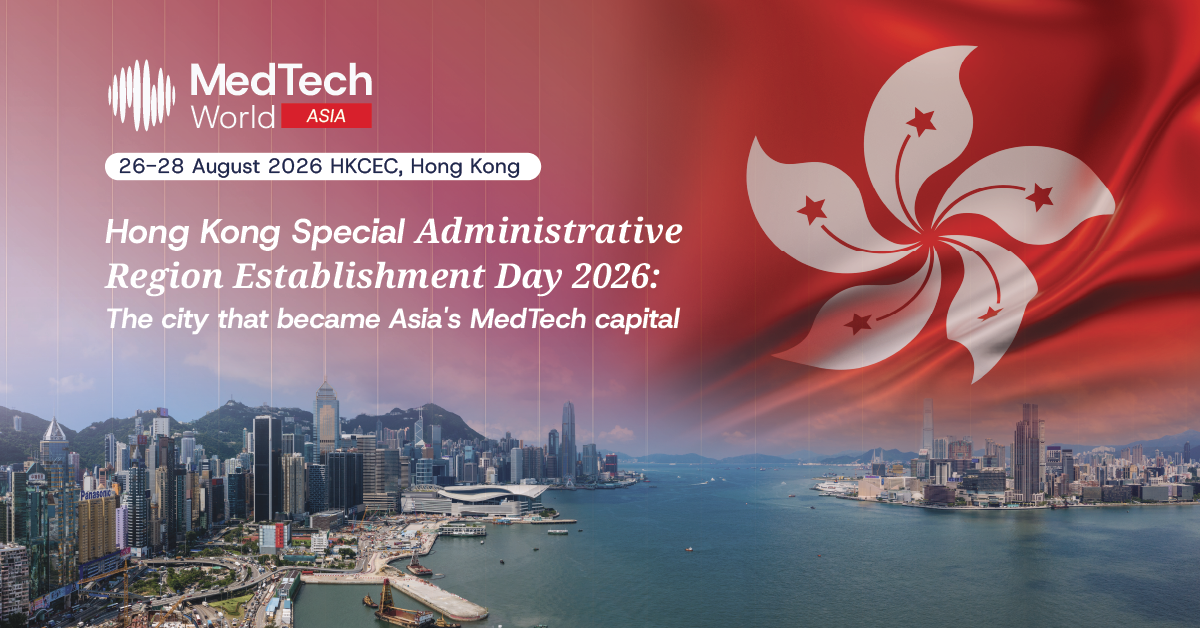
MedTech World Asia is coming to Hong Kong, 26–28 August 2026, at the HKCEC, bringing together regulators, hospital executives, investors, and innovators shaping healthcare across APAC. If you’re exploring Hong Kong as your gateway for MedTech investment or expansion, this is where those conversations will happen. Learn more and get your pass to MedTech World Asia 2026 now.