- Summits
- Sponsorship
- Retreats
- Media Opportunities
- News
- About
Each year, nearly 800,000 people in the United States experience a stroke. For many, survival and recovery hinge on a race against the clock, one where minutes, not hours, can determine whether a patient walks out of the hospital or lives with permanent disability. Yet for a particularly vulnerable group, patients who suffer a stroke inside the hospital, those minutes too often stretch into dangerous delays.
It is against this backdrop that Ceribell has secured a breakthrough device designation from the US Food and Drug Administration (FDA) for its large vessel occlusion (LVO) stroke detection monitoring tool, marking a notable step forward in the push for faster, more reliable in-hospital stroke detection.
While most people associate stroke with emergency admissions, research shows that between 35,000 and 75,000 strokes occur annually within US hospitals. These in-hospital strokes are frequently linked to poorer outcomes, not because treatment options are lacking, but because detection is delayed. Non-standardised protocols, competing clinical priorities, and subtle early symptoms often mean precious time is lost before intervention begins.
For LVO strokes, among the most severe and disabling types, those delays can be devastating.
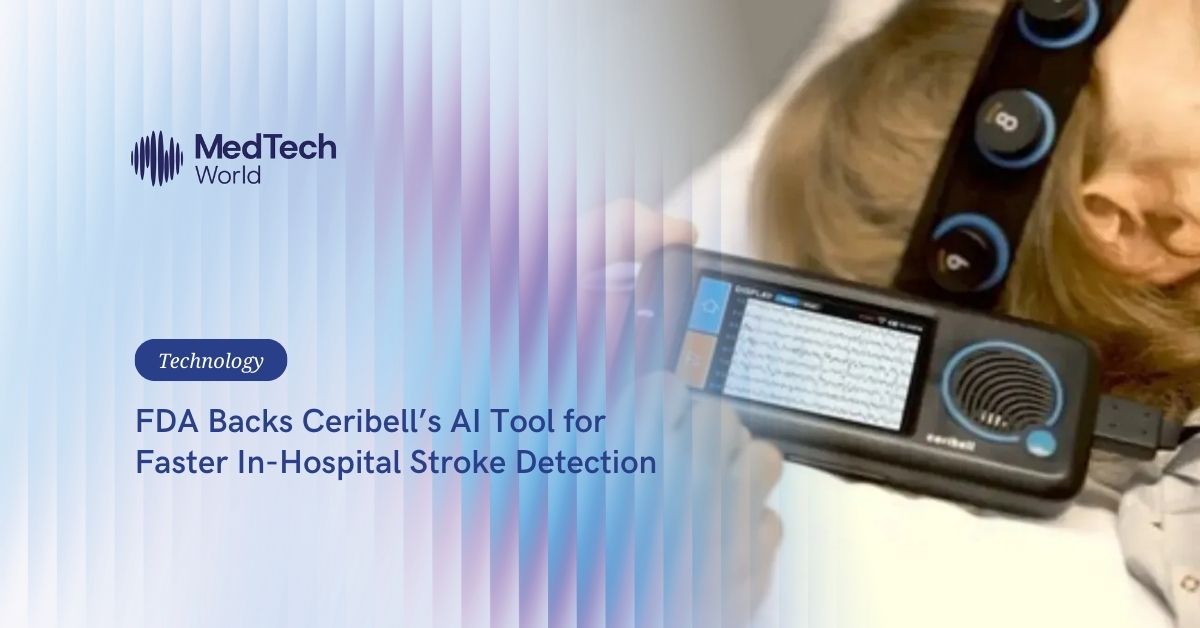
Ceribell’s newly designated tool builds on its point-of-care EEG platform, the Ceribell EEG System. The system includes a 10-electrode headband and EEG recorder, designed for rapid application without the need for specialist setup.
What makes the LVO stroke application different is the intelligence layered on top. Using AI-based algorithms, the system analyses EEG signals in real time, searching for early neurological patterns associated with large vessel occlusion strokes in hospitalised patients. The goal is not to replace imaging or clinical judgement, but to flag potential strokes earlier, prompting faster escalation and treatment.
In environments where every delay compounds harm, that early signal could be decisive.
The FDA’s breakthrough designation reflects more than a single new application; it signals confidence in Ceribell’s broader platform approach.
The Ceribell EEG System first gained FDA clearance in 2017, with indications for seizure detection and delirium monitoring, supported by the company’s Clarity AI algorithm. In April 2025, Clarity received an additional indication for electrographic seizure monitoring in paediatric patients, including children as young as one year old.
The LVO stroke designation continues this trajectory, extending EEG-based monitoring into yet another high-impact neurological use case.
Commenting on the designation, Ceribell CEO Jane Chao emphasised the human cost of delayed detection in hospital settings.
“At a time when minutes matter, patients with in-hospital stroke often experience hours of delay,” she said. “Ceribell is proud that this FDA [breakthrough device designation] recognises the potential of the Ceribell System to provide accurate and timely detection of LVO stroke for this vulnerable patient population.”
The FDA’s breakthrough programme is designed to accelerate the development and review of technologies that address unmet medical needs, particularly where earlier diagnosis could materially improve outcomes.
Stroke care has long been defined by speed, but speed depends on detection. By bringing AI-driven analysis directly to the bedside, Ceribell’s approach challenges a persistent blind spot in hospital care, one where strokes happen in plain sight, yet go unrecognised for too long.
If successful, earlier identification of LVO strokes in hospitalised patients could mean faster treatment decisions, reduced disability, and better chances of recovery. In a disease where the burden is measured in lives altered and years lost, that shift could make all the difference.
Taking place from 11 to 13 February 2026, MedTech World Middle East | Dubai brings together clinicians, health system leaders, regulators, and MedTech innovators to examine how AI-driven monitoring and smarter diagnostics can reduce delays in care and support better clinical decisions. Reserve your place and be part of focused, real-world conversations in healthcare.