- Summits
- Sponsorship
- Retreats
- Media Opportunities
- News
- About
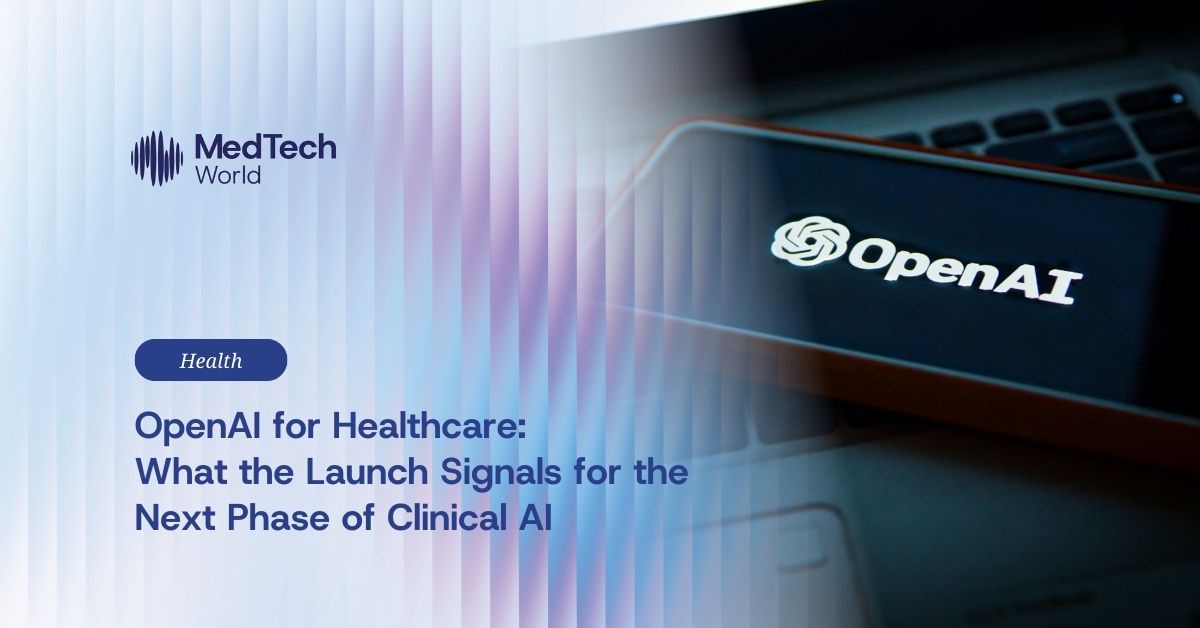
On 7 January 2026, OpenAI announced the launch of OpenAI for Healthcare, a dedicated initiative aimed at supporting clinicians, healthcare organisations, and MedTech companies with HIPAA-compliant artificial intelligence tools. The announcement reflects a broader shift in healthcare AI, from experimentation and pilot projects to deployment within real clinical environments, where safety, governance, and workflow integration are non-negotiable.
As healthcare systems face mounting pressure from rising patient volumes, workforce shortages, and administrative overhead, OpenAI’s healthcare-focused offering seeks to address a core challenge: how AI can scale support for clinicians without adding complexity or risk.
At the centre of the launch is ChatGPT for Healthcare, alongside enhanced API tools designed specifically for clinical and enterprise use cases. These tools are built to meet healthcare compliance requirements while allowing organisations to maintain full control over their data. OpenAI has confirmed that healthcare data processed through these systems is not used for model training, addressing one of the sector’s most persistent concerns around data governance.
Early adopters include major U.S. healthcare institutions such as AdventHealth, Cedars-Sinai, and UCSF, signalling early confidence from providers already operating at scale.
ChatGPT for Healthcare is powered by GPT-5.2 and has been evaluated using physician-led benchmarks, including HealthBench and GDPval, which assess clinical relevance, reasoning quality, and safety.
Key features include:
Together, these capabilities reflect a move away from general-purpose AI tools toward systems that can operate within regulated healthcare environments.
Alongside its enterprise offering, OpenAI is expanding consumer access through ChatGPT Health, a feature that allows users to connect medical records, wellness applications, and wearable devices to receive personalised health insights. Currently available via waitlist, this tool supports users across Free, Go, Plus, and Pro plans in select regions.
Importantly, OpenAI has positioned ChatGPT Health as non-diagnostic, focusing instead on helping users understand lab results, trends, and general health information. Early electronic health record (EHR) integrations are limited to the U.S., underlining the company’s emphasis on privacy and regulatory alignment.
The launch builds on several years of groundwork. OpenAI has collaborated with more than 260 physicians across 60 countries to evaluate and refine its healthcare models. Partnerships with clinical documentation specialists such as Abridge and Ambience, as well as life sciences organisations including Amgen, point to a strategy that spans care delivery, clinical operations, and research.
Previous milestones include the release of HealthBench in 2025 and strategic hires such as Nate Gross, focused on healthcare direction. Looking ahead, OpenAI has indicated potential expansions into deeper EHR integrations, multimodal imaging analysis, and predictive analytics—areas that remain closely watched by regulators and healthcare leaders alike.
For MedTech organisations, OpenAI for Healthcare reinforces several key trends:
Studies such as those conducted by Penda Health suggest that well-integrated AI tools can reduce documentation errors and clinician burden. Meanwhile, data from the American Medical Association shows physician use of AI tools doubling year over year—an indicator that adoption is accelerating, provided trust and compliance requirements are met.
For MedTech companies operating across regions with complex regulatory frameworks, including the Middle East, the launch raises important questions around deployment readiness, data sovereignty, and patient safety.
These developments will be front and centre at MedTech World Middle East | Dubai 2026, where founders, hospital leaders, regulators, and technology providers will examine how AI moves from concept to clinical reality.
One of the key sessions addressing this shift is the panel discussion “AI in Healthcare: From Hype to Hospital-Ready Solutions”, which will explore what healthcare systems actually require before AI tools are deployed at scale, across governance, validation, integration, and patient safety.
If you are building, deploying, or evaluating AI in healthcare, these conversations will be essential. Book your ticket to MedTech World Middle East | Dubai 2026 and join the discussions advancing the next phase of healthcare technology.