- Summits
- Sponsorship
- Retreats
- Media Opportunities
- News
- About
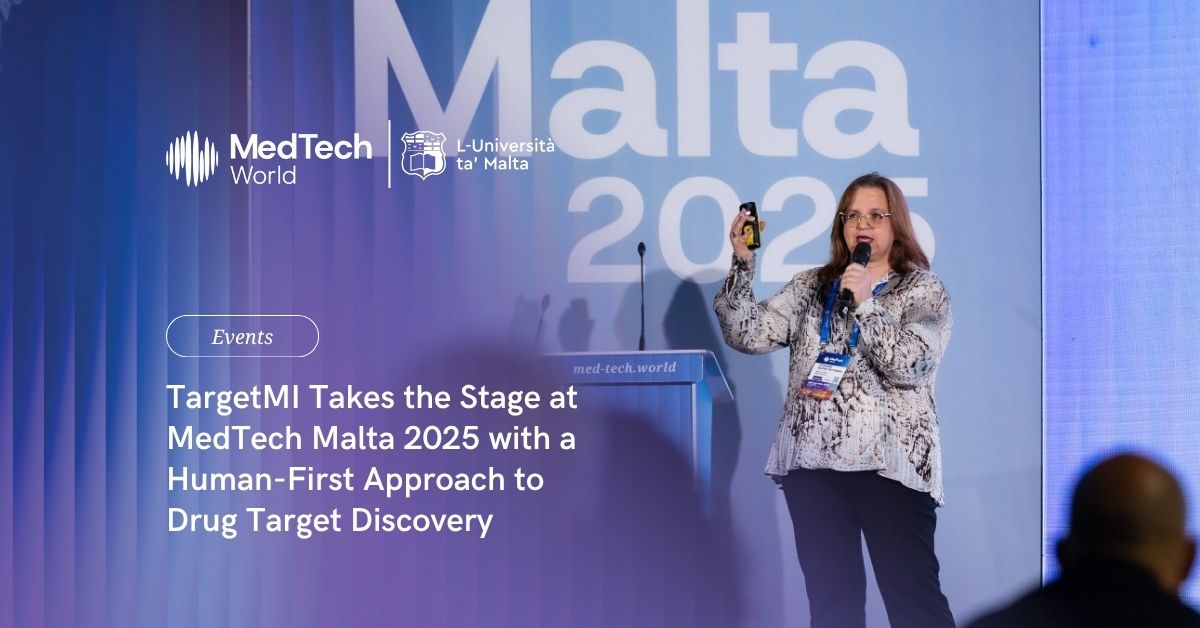
One of the standout company showcases on Day 2 at MedTech Malta 2025 came from Stephanie Bezzina Wettinger, Professor and Principal Investigator, University of Malta, Genomics of Complex Diseases and Myocardial Infarction, who brought the TargetMI project to the Sacra Infermeria stage in front of an audience of global investors, innovators, and individuals committed to advancing science. Representing the University of Malta, she introduced a research effort that is drawing attention across Europe: TargetMI: A Multi-Omics Approach for Novel Drug Targets, Biomarkers and Risk Algorithms for Myocardial Infarction, supported by a €4 million grant from the EU’s EIC Pathfinder Cardiogenomics Challenge, in partnership with Leiden University Medical Center.
From the outset, Professor Wettinger addressed a challenge that continues to hold back progress in drug development. Despite years of effort and substantial investment, the majority of drug candidates still fail, often after long development timelines and costs that can reach billions. TargetMI responds to this issue by starting where it matters most: human data. Instead of moving from animal models to small-scale human validation at a later stage, the project begins with an exceptionally deep, high-quality human dataset designed to highlight the most promising biological targets early on.
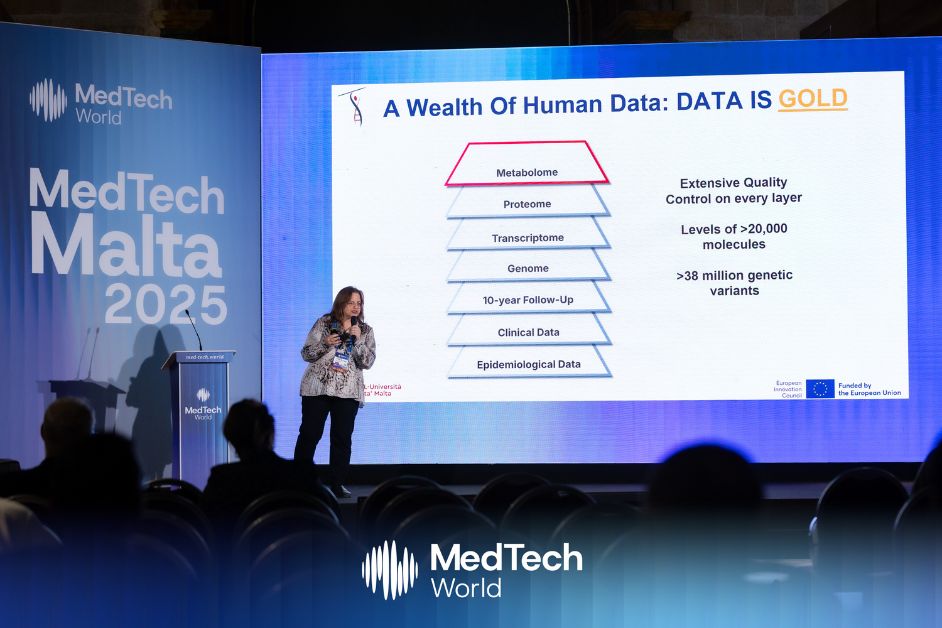
The dataset behind TargetMI is one of its greatest strengths. It includes measurements of more than 20,000 molecules per participant and over 38 million genetic variants, all collected under tightly controlled conditions. Every sample is processed within an hour, and participants are screened to exclude recent vaccinations, infections, or surgeries, ensuring consistency across the entire biobank. All the layers of data come from the exact same samples, building a dataset that Professor Wettinger described as “gold-standard” in terms of both depth and precision. It is an approach that gives researchers the ability to explore disease pathways with a clarity that traditional models cannot provide.
On stage, she explained how TargetMI’s computational engine can sift through tens of thousands of biological variables to identify which genes influence a particular marker or trait. The platform offers researchers a clear understanding of regulatory relationships, supported by robust evidence drawn directly from human biological reality. This process has already helped the team challenge assumptions. One example she shared involved a protein widely discussed in the literature as a potential target for heart attack prevention. While theory suggested its promise, TargetMI’s genetic data told a different story: a natural variant that truncates the protein not only failed to reduce heart attack risk but also increased the risk of diabetes. Insights like these help prevent years of misplaced investment.
Underlying these analyses is a biobank built with meticulous attention to detail. Participants contribute medical histories, previous hospital test results, and updated blood samples, and the dataset includes up to ten years of follow-up. By keeping every variable consistent and combining multiple layers of biological data, the team is able to study disease processes in a way that is far more integrated than conventional approaches.
The project is evolving quickly. TargetMI is developing TargetID, a tool that will allow researchers and industry partners to explore the dataset even further. Additional layers, such as metabolomics, along with external datasets, will be added in the coming year, expanding the possibilities for discovery. The ultimate goal is to move toward validated candidate targets for myocardial infarction by 2027, with bioinformatics services and tools ready to be offered commercially by 2028.
Professor Wettinger also highlighted the team supporting TargetMI, a group that brings together decades of experience across molecular biology, disease modelling, rare disease research, multi-omics, bioinformatics, and AI. Their collective expertise has helped the project secure €8.5 million in competitive research funding since 2020, strengthening its foundation and accelerating its development.
As she concluded her presentation, Professor Wettinger invited collaborators from pharma, diagnostics, biotech, and academia to explore partnership opportunities with TargetMI. For the audience at MedTech Malta 2025, the showcase offered a clear view of a project that is combining rigorous science with thoughtful strategy and positioning Malta as a contributor to meaningful advances in cardiovascular research.
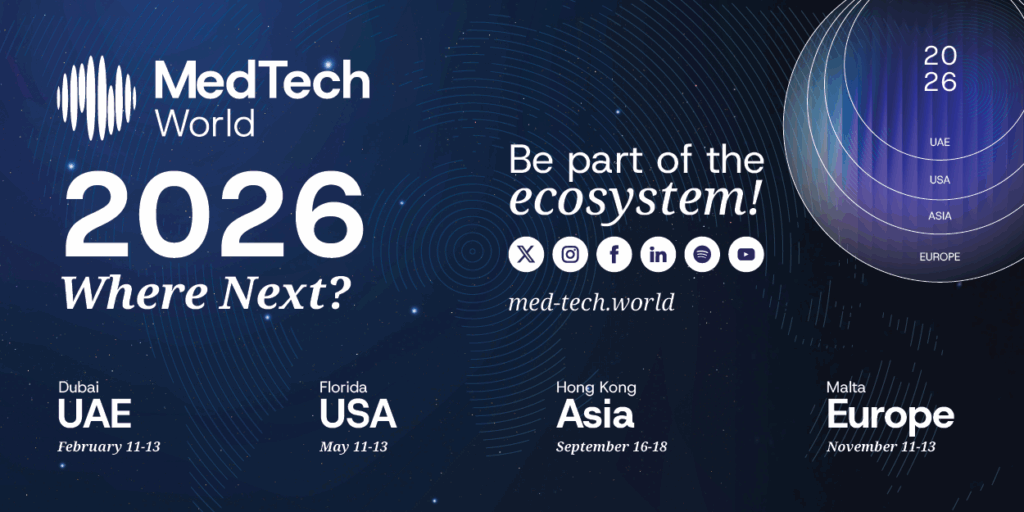
With MedTech Malta 2025 now setting the tone for a year of forward-looking conversations, MedTech World is gearing up for its four flagship gatherings in 2026. Innovators, founders, clinicians, policymakers, and investors who want to take part in the next chapter are invited to register their interest and be part of the global community that continues to move the field forward.